Reptiles
Burmese python
Python bivittatus
- Group
- Reptiles
- Size class
- Medium (10–70 kg)
- Family
- Pythonidae
Range
- North America
- Asia
Habitat
- Wetland
- Rainforest
Range
Countries it is found in
13 countries
- Bangladesh
- Bhutan
- Cambodia
- China
- Hong Kong SAR China
- India
- Indonesia
- Myanmar (Burma)
- Nepal
- Taiwan
- Thailand
- United States
- Vietnam
Range from:GBIF occurrence records — read 2026-08-05
Chapter 01
Overview
The Burmese python (Python bivittatus) is one of the largest snakes in the world, native to a wide area of southern and South-east Asia: eastern India, south-eastern Nepal, western Bhutan, south-eastern Bangladesh, Myanmar, Thailand, Laos, Cambodia, Vietnam, northern peninsular Malaysia, southern China, Hong Kong and the Indonesian islands of Java, southern Sulawesi, Bali and Sumbawa. Until 2009 it was treated as a subspecies of the Indian python; Swedish has called it burmesisk pyton or burmesisk tigerpyton. It lives in grassland, marsh, swamp, rocky foothills, woodland, river valleys and jungle with clearings, always near permanent water. In its native range it has been listed as vulnerable by the IUCN since 2012, after the wild population fell by at least 30 percent in a decade through habitat loss and over-harvesting, and it is protected in Hong Kong, Thailand, Vietnam, China and Indonesia. In Florida it is the opposite: an invasive species from the pet trade, established in the Everglades after more than 90,000 were imported into the US between 1996 and 2006, with escapes blamed partly on Hurricane Andrew's destruction of a breeding facility in 1992. The Everglades population, genetically a hybrid of Burmese and Indian pythons, was estimated in 2024 at anywhere from 30,000 to 300,000.
Chapter 02
Identification
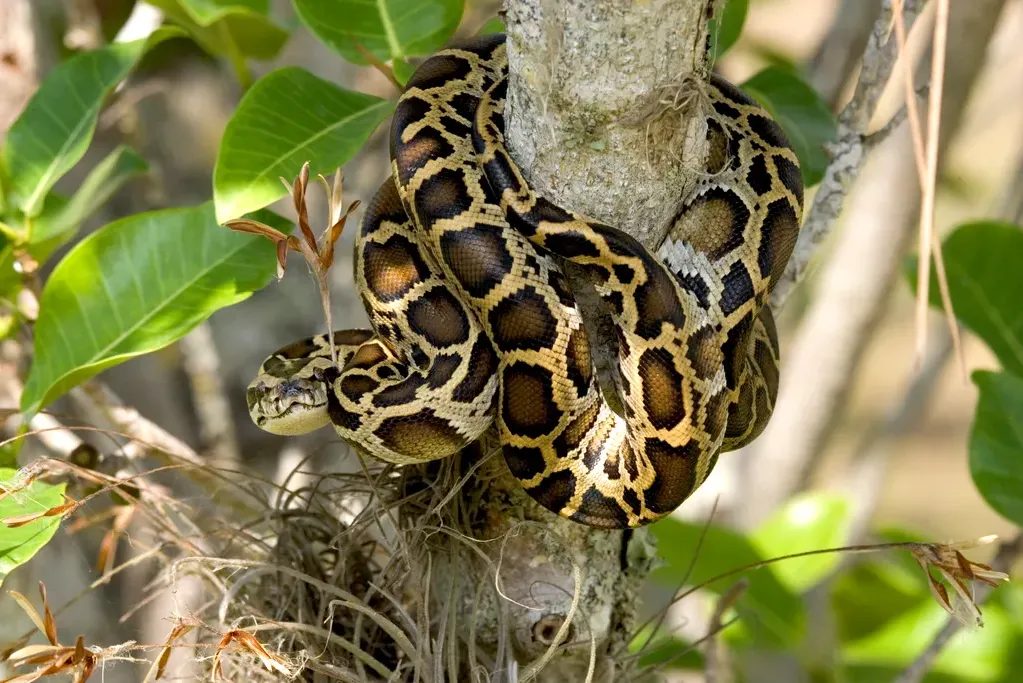
A dark, non-venomous constrictor with many brown blotches bordered with black down the back. In the wild it typically grows to about 5 m, averaging 3.7 m; specimens over 5 m are rare and claims beyond 7 m are unconfirmed. The longest on record, 5.79 m, was caught in Big Cypress National Preserve in Florida on 10 July 2023. Females are only slightly longer than males but much heavier and bulkier: a captive female of 5 m weighed 75 kg, while males of about 3 m weighed 7–18.5 kg. A captive female named Baby weighed 182.8 kg at her death, far more than any wild snake measured. Adults are at least 2.35 m long, but dwarf island forms on Java, Bali and Sulawesi average about 2 m. The darker colouring and larger size distinguish it from the paler Indian python, which usually stays around 3 m.
Chapter 03
Behaviour
Burmese pythons are mainly nocturnal and spend most of their time hidden in undergrowth. Young snakes climb as readily as they move on the ground, but heavy adults keep mostly to the ground; they are excellent swimmers and can stay submerged for half an hour. In the north of the native range — and in Florida — they brumate through the cold season in hollow trees, riverbank holes or under rocks, yet freezes can still kill up to 90 percent of Florida pythons. They are sit-and-wait predators that strike, seize prey with their teeth, kill it by constriction and swallow it whole, feeding every month or two and fasting for up to 18 months; after a meal the gut rebuilds itself and the heart ventricle grows by 40 percent. Mammals and birds make up most of the diet. In Florida they eat foxes, rabbits and raccoons, and have taken deer and small alligators: where they are established, raccoon sightings are down 99.3 percent, opossums 98.9 percent and white-tailed deer 94.1 percent. Females lay 12–36 eggs in March or April and coil around them, twitching their muscles to warm the clutch by several degrees.
Chapter 04
Hunting
In Florida the Burmese python is hunted to remove it. The state added it to its prohibited species list in April 2021, and like all non-native reptiles it is protected only by anti-cruelty law. It may be humanely killed on private land at any time with the landowner's permission, with no permit or hunting licence, and is open year-round on 32 lands managed by the Florida Fish and Wildlife Conservation Commission with no permit, licence or bag limit, under the rules of each area. Snakes must be humanely killed on the spot where they are caught; carrying them away alive is not allowed. The US banned imports of Burmese pythons in January 2012. Pythons favour broad-leaved and lightly flooded habitat, raised ground for nesting and the edges of habitats, which is where hunters look for them. Since 2013 the Florida Python Challenge has drawn the public in: 68 pythons were removed in the first month-long contest, 209 by 1,050 participants in 2023, and in the ten-day 2026 challenge 907 participants from 30 states, Canada and Vietnam removed 280.
On the table
Meat & cooking
Table grade 1 of 51/5
- Sold as meat in a legal market
- Has a named traditional dish
- Published way to handle and cook it
- Eaten in more than one country
- No known health advisory
Before you eat it: The Florida Department of Health has issued a 'Do Not Consume Python' advisory for Burmese pythons caught in Florida, whatever their size: some Everglades pythons tested for mercury carried levels too high for people to eat safely. Eating python is not illegal, but the state recommends against it.
Sources
Sources: Burmese python — Wikipedia, Tigerpyton — Wikipedia (sv), Florida Fish and Wildlife Conservation Commission: Burmese python, Florida Fish and Wildlife Conservation Commission: Removing pythons in Florida, Florida Fish and Wildlife Conservation Commission: 280 invasive Burmese pythons removed in the 2026 Python Challenge — read 2026-10-29
Cross-reference
Related species
Its closest relatives in the compendium, nearest kinship first.