Waterfowl
Eurasian coot
Fulica atra
- Group
- Waterfowl
- Size class
- Small (under 10 kg)
- Family
- Rallidae
Range
- Europe
- Asia
- Oceania
Habitat
- Wetland
Range
Countries it is found in
106 countries
- Afghanistan
- Albania
- Algeria
- Andorra
- Armenia
- Australia
- Austria
- Azerbaijan
- Bahrain
- Bangladesh
- Belarus
- Belgium
- Bhutan
- Bosnia & Herzegovina
- Brunei
- Bulgaria
- Cambodia
- China
- Croatia
- Cyprus
- Czechia
- Denmark
- Egypt
- Estonia
Range from:Wikipedia country bird lists, GBIF occurrence records — read 2026-08-05
Chapter 01
Overview
The Eurasian coot (Fulica atra) is a rail of Europe, Asia, Australia, New Zealand and parts of North Africa, breeding on freshwater lakes and ponds and well adapted to town parks. Linnaeus described it in 1758, and the type locality is now restricted to Sweden; fulica means coot and atra black. Birds in the milder parts of the range are resident, while those from frozen waters move south and west for the winter. In Sweden the sothöna is common on lakes and bays rich in vegetation in Götaland and Svealand and along the southern Norrland coast. Most Swedish birds migrate, many only far enough to escape the ice, wintering in harbours further south. The Swedish population shows no major change and is assessed as least concern.
Chapter 02
Identification
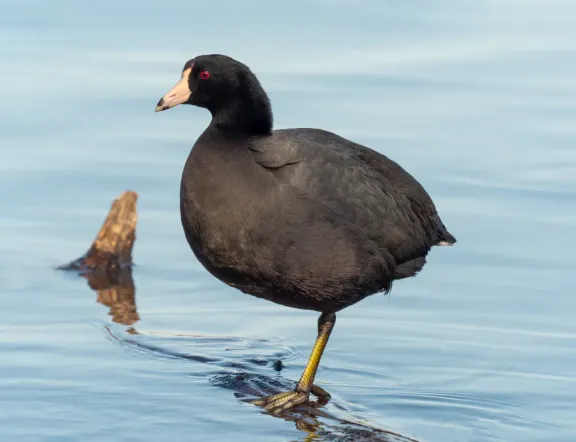
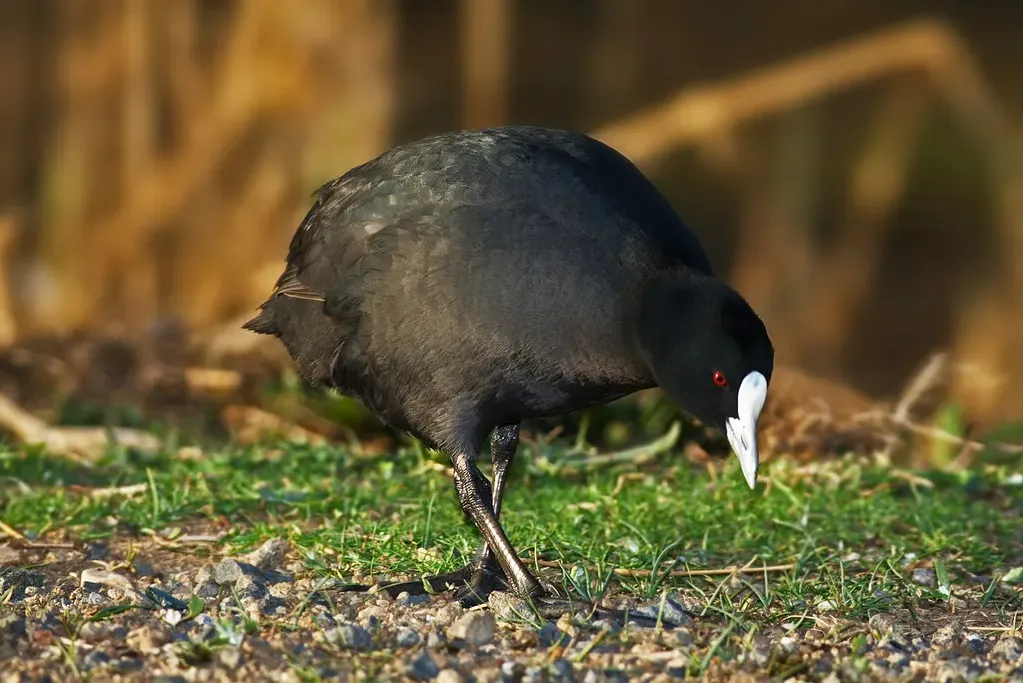
A rounded, slaty-black waterbird 36–38 cm long with a 70–80 cm wingspan; males weigh around 890 g and females 750 g. The white bill and bare white frontal shield are unmistakable — the source of the phrase 'as bald as a coot', in use by 1430 — and the iris is red. The toes are not webbed but carry lobes, like a grebe's. The sexes are alike, though the male's shield is larger. Juveniles are paler with a whitish breast and no shield; the downy chicks have red heads. It is noisy, with a wide repertoire of crackling, explosive and trumpeting calls, often given at night.
Chapter 03
Behaviour
Coots are much less secretive than most rails, swimming on open water and walking on waterside grass. They are aggressive and strongly territorial when breeding, charging rivals and striking them with their feet, but form large flocks outside the breeding season. Reluctant fliers, they patter across the surface with much splashing to take off, yet migrate long distances at night. A coot bobs its head as it swims and makes short dives from a little jump. The bulky nest floats on the water or sits on a submerged stump. Six to ten buff, dark-speckled eggs are incubated by both parents for 21–24 days, and the young fledge at 55–60 days; parents often split the brood between them. The coot is omnivorous, taking water plants, algae, seeds, insects, molluscs and the eggs of other waterbirds.
Chapter 04
Hunting
The Eurasian coot is one of the species covered by the Agreement on the Conservation of African-Eurasian Migratory Waterbirds (AEWA). In Sweden the sothöna has no open season in the hunting ordinance, and it is not among the birds named for skyddsjakt on the hunter's own initiative in its bilaga 4.
Sources
Sources: Eurasian coot — Wikipedia, Sothöna — Wikipedia (svenska), Jaktförordning (1987:905) — Sveriges riksdag — read 2026-10-29
Cross-reference
Related species
Its closest relatives in the compendium, nearest kinship first.