Upland birds
Jack snipe
Lymnocryptes minimus
- Group
- Upland birds
- Size class
- Small (under 10 kg)
- Family
- Scolopacidae
Range
- Europe
- Asia
Habitat
- Wetland
Range
Countries it is found in
75 countries
- Afghanistan
- Albania
- Algeria
- Armenia
- Austria
- Azerbaijan
- Bahrain
- Bangladesh
- Belgium
- Bosnia & Herzegovina
- Bulgaria
- China
- Croatia
- Cyprus
- Czechia
- Denmark
- Egypt
- Estonia
- Faroe Islands
- Finland
- France
- Georgia
- Germany
- Greece
Range from:Wikipedia country bird lists — read 2026-08-05
Chapter 01
Overview
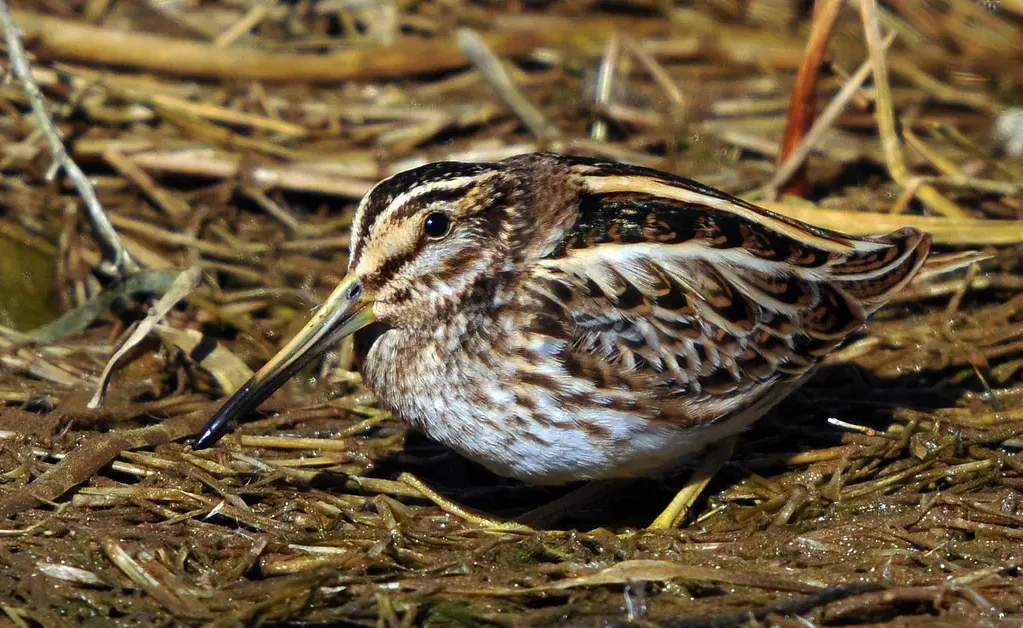
The jack snipe (Lymnocryptes minimus) is the smallest snipe and the only member of its genus; genetic studies suggest it is closest to the woodcocks rather than to the other snipes. Brünnich described it in 1764 from the Danish island of Christiansø. The genus name is Greek for 'hidden in the marsh', minimus Latin for 'smallest', and 'jack', modern dictionaries say, comes from the man's name — though Alfred Newton suggested it might point to the bird's small size, the jack being the smallest ball in bowls. It breeds in marshes, bogs, tundra and wet meadows with short vegetation in northern Europe and northern Russia, east to the Kolyma, and winters in Britain, Atlantic and Mediterranean Europe, Africa and India. In Sweden it breeds almost only on wet mires from northern Dalarna to Torne lappmark, leaving in October–November and returning to southern Sweden from March. AEWA, the African-Eurasian waterbird agreement, applies to it.
Chapter 02
Identification
Smaller than the common snipe, at about two-thirds the size, with a much shorter bill: 18–25 cm long, with a 30–41 cm wingspan and a weight of 33–73 g. It is mottled brown above and pale below, with a dark stripe through the eye; the narrow pointed wings show yellow back stripes in flight. The head settles it: there is no pale central crown-stripe, but two pale lateral stripes separated from the supercilium by dark feathering. On the ground it bobs continuously, as if on springs.
Chapter 03
Behaviour
Secretive and well camouflaged in winter, the jack snipe squats and will not flush until an intruder is very close, then flies quietly a short way before dropping back into cover — which is why birdwatchers find it by walking through its marshes until one gets up. It forages in soft mud, probing or picking food by sight, mainly insects and earthworms with some plant material. The male's aerial display is accompanied by a hollow, hard-to-place sound like a distant galloping horse; the bird is silent in winter. The nest is well hidden on the ground and holds three or four eggs.
Chapter 04
Hunting
In Sweden the jack snipe has no open season in the Hunting Ordinance, either in its current form or in the version that takes effect on 1 July 2027.
Field data
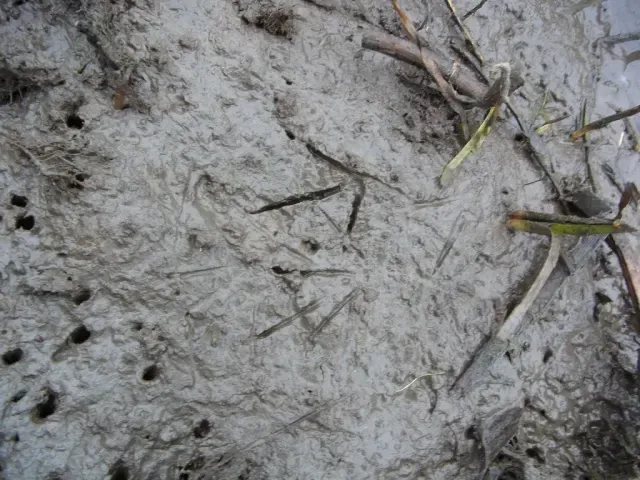
Tracks
A photograph of real sign left by Jack snipe. Prints vary with gait, ground and how long they have been there — treat this as one example, not a template.
Track photo:Donkey shotCC BY-SA 4.0
Sources
Sources: Jack snipe — Wikipedia, Dvärgbeckasin — Wikipedia, Jaktförordning (1987:905) — Sveriges riksdag — read 2026-10-29
Cross-reference
Related species
Its closest relatives in the compendium, nearest kinship first.
Upland birds
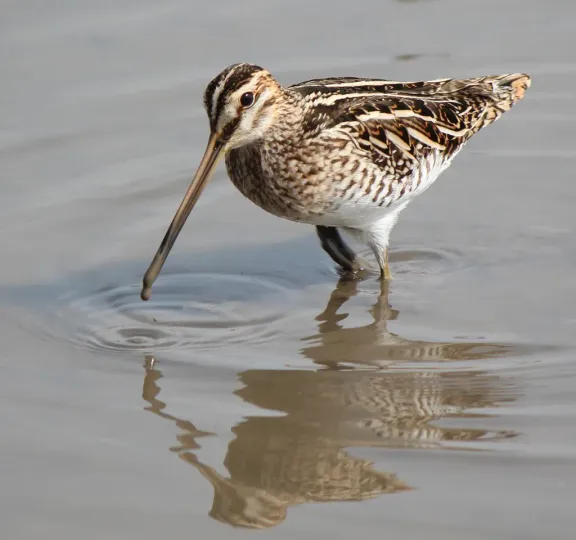
Common snipe
Gallinago gallinago
Same family (Scolopacidae)
Upland birds
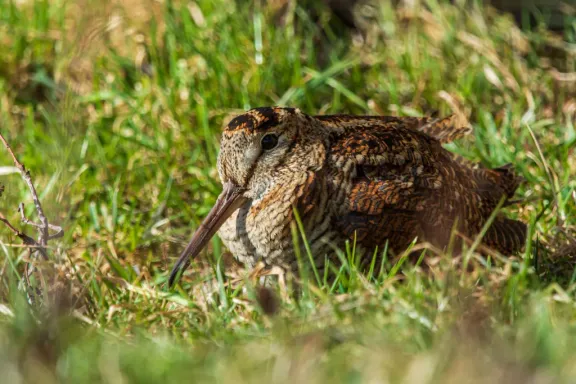
Eurasian woodcock
Scolopax rusticola
Same family (Scolopacidae)
Upland birds
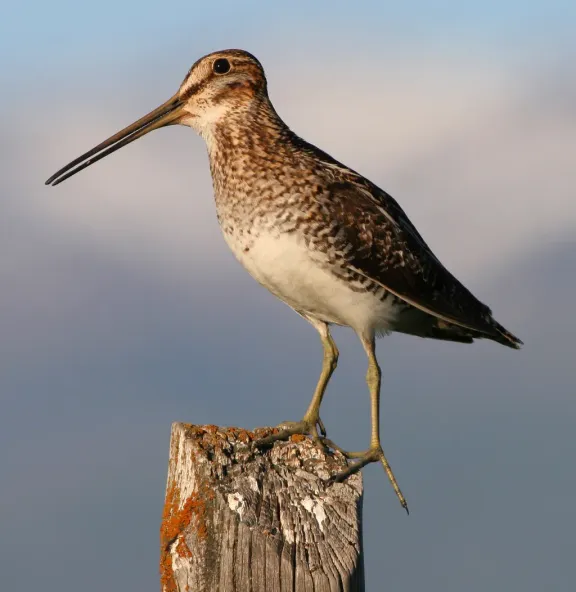
Wilson’s snipe
Gallinago delicata
Same family (Scolopacidae)
Upland birds
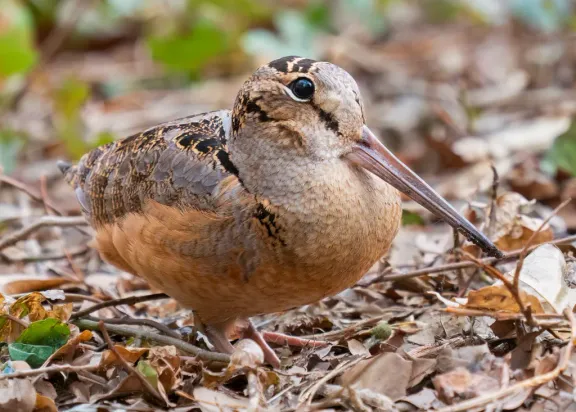
American woodcock
Scolopax minor
Same family (Scolopacidae)