Upland birds
Eurasian woodcock
Scolopax rusticola
- Group
- Upland birds
- Size class
- Small (under 10 kg)
- Family
- Scolopacidae
Range
- Europe
- Asia
Habitat
- Forest
- Wetland
Range
Countries it is found in
81 countries
- Afghanistan
- Åland Islands
- Albania
- Andorra
- Armenia
- Austria
- Azerbaijan
- Bangladesh
- Belarus
- Belgium
- Bhutan
- Bosnia & Herzegovina
- Brunei
- Bulgaria
- Cambodia
- China
- Croatia
- Cyprus
- Czechia
- Denmark
- Estonia
- Faroe Islands
- Finland
- France
Range from:Wikipedia country bird lists, GBIF occurrence records — read 2026-08-05
Chapter 01
Overview
The Eurasian woodcock (Scolopax rusticola) is a medium-small wading bird of temperate and subarctic Eurasia that lives in woodland rather than on open water. It probes the ground for food with a long, sensitive bill, which makes it vulnerable to cold weather when the ground stays frozen. Linnaeus described it in 1758. The genus name is Latin for a snipe or woodcock; the epithet rusticola is the Latin name of a gamebird mentioned by Pliny the Elder and Martial — possibly a grouse. The species is monotypic, with no subspecies recognised.
Chapter 02
Identification
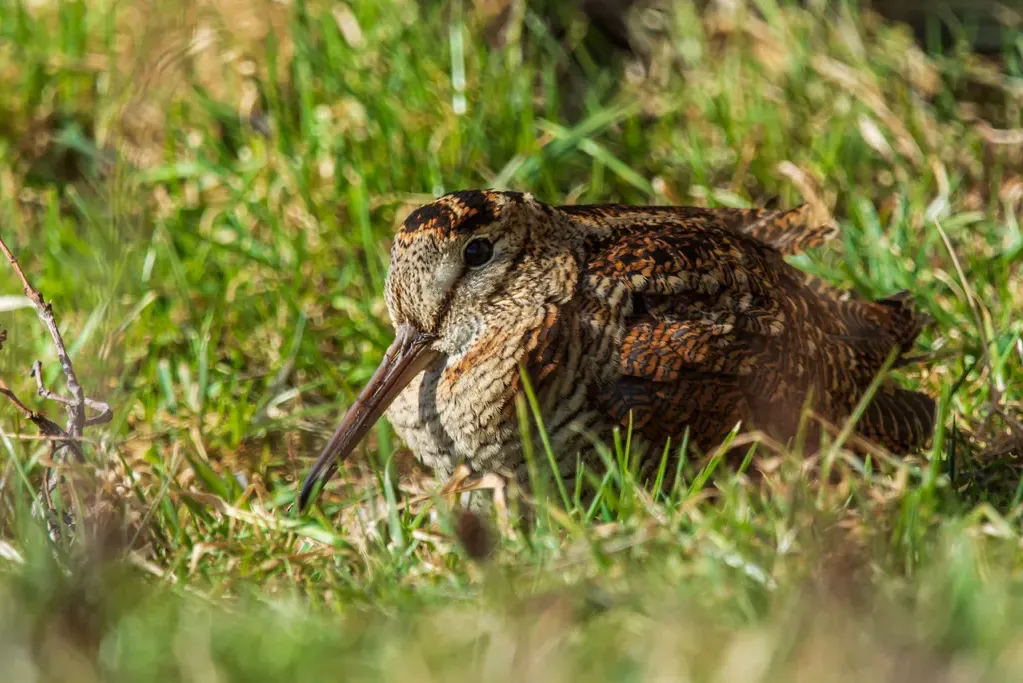
Adults are 33–38 cm long including the 6–8 cm straight bill, with a 55–65 cm wingspan. The camouflage is cryptic and suited to woodland: intricately patterned reddish-brown upperparts and buff underparts. The head is the identifying detail — barred with black, not striped as in the closely related snipe. The eyes are large and set high on the sides of the head, far enough back to give the bird 360-degree vision.
Chapter 03
Behaviour
Woodcock are crepuscular, most active at dawn and dusk and rarely moving by day unless flushed, when they go off with a whirring of wings. The flight is somewhat owl- or bat-like: fast and direct when migrating or crossing open country, erratic and twisting and fluttering once back inside woodland. They are usually solitary and migrate singly, though weather or geography can concentrate them. The male performs a courtship display flight called roding at dusk between April and June, with a call of orr, orr, orr, pist. A study of spectrograms found 95 per cent of calls could be attributed correctly to individual birds, which is why counting roding males works as a way of monitoring the population.
Chapter 04
Hunting
Woodcock are hunted as game in many countries, and their size, speed and flight pattern make them a very challenging shot. Anyone who shoots a witnessed 'right and left' — two woodcock killed with consecutive shots from a shotgun, without the gun being lowered or reloaded — can be admitted to the Shooting Times Woodcock Club.
Field data
Tracks
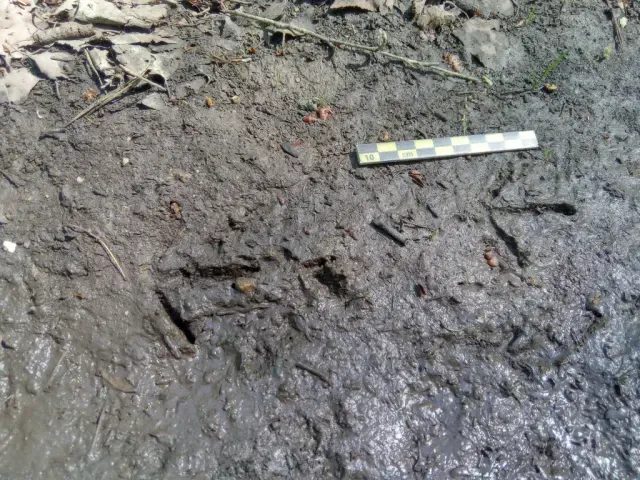
A photograph of real sign left by Eurasian woodcock. Prints vary with gait, ground and how long they have been there — treat this as one example, not a template.
Track photo:Полина ПолежанкинаCC BY
On the table
Meat & cooking
Table grade 5 of 55/5
- Sold as meat in a legal market
- Has a named traditional dish
- Published way to handle and cook it
- Eaten in more than one country
- No known health advisory
Traditional preparations
- Roast woodcock
- Traditionally roasted whole and undrawn, the long bill used to skewer the bird and the trail spread on toast beneath it. Salmis — Wikipedia
- Salmis
- Briefly roasted, jointed, then finished in a sauce built from the carcass — the classic French treatment of a small game bird. Salmis — Wikipedia
Sources
Sources: Eurasian woodcock — Wikipedia — read 2026-08-05
Cross-reference
Related species
Its closest relatives in the compendium, nearest kinship first.
Upland birds
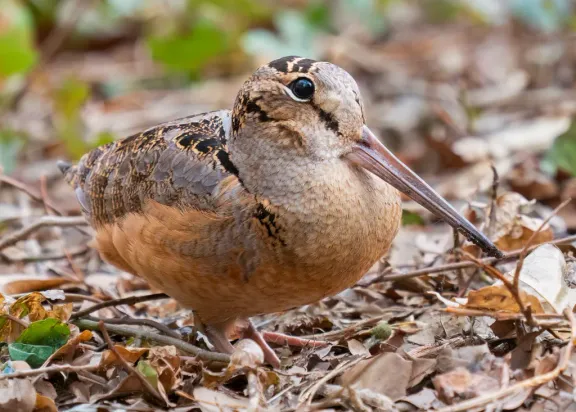
American woodcock
Scolopax minor
Same genus (Scolopax)
Upland birds
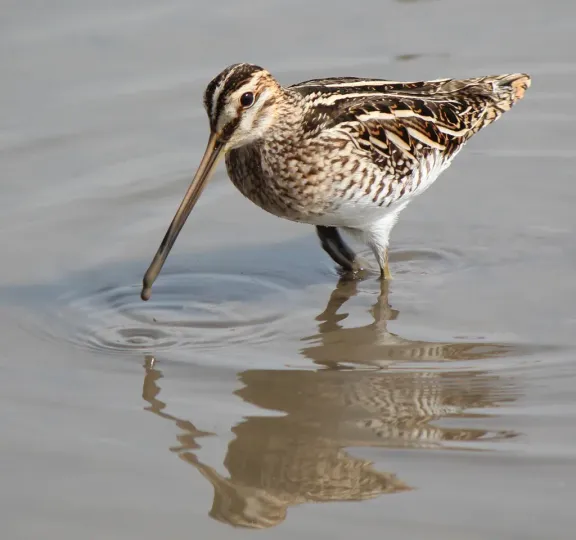
Common snipe
Gallinago gallinago
Same family (Scolopacidae)
Upland birds
Jack snipe
Lymnocryptes minimus
Same family (Scolopacidae)
Upland birds
Wilson’s snipe
Gallinago delicata
Same family (Scolopacidae)