Predators & furbearers
American mink
Neogale vison
- Group
- Predators & furbearers
- Size class
- Small (under 10 kg)
- Family
- Mustelidae
Range
- North America
- Europe
Habitat
- Wetland
Range
Countries it is found in
44 countries
- Austria
- Belarus
- Belgium
- Canada
- Chile
- China
- Colombia
- Czechia
- Denmark
- Egypt
- Estonia
- Finland
- France
- Georgia
- Germany
- Greece
- Hungary
- Iceland
- Ireland
- Isle of Man
- Italy
- Japan
- Kazakhstan
- Liechtenstein
Range from:ASM Mammal Diversity Database, GBIF occurrence records — read 2026-08-05
Chapter 01
Overview
The American mink (Neogale vison) is a semiaquatic mustelid native to North America, carried by people to much of Europe, Asia and South America. It is the animal most often farmed for its fur, ahead of the silver fox, sable, marten and skunk, and in its introduced European range it is classed as invasive and linked to declines in the European mink, the Pyrenean desman and the water vole. The first animals reached Europe in 1920 for fur farming. Mink have been kept in the Nordic countries since the mid-1920s; the post-war growth of the industry brought more escapes and rapid spread, and every wild Nordic mink descends from farmed stock. It is now found in almost all of Sweden, where it is classed as invasive — to be managed, and eradicated where possible.
Chapter 02
Identification
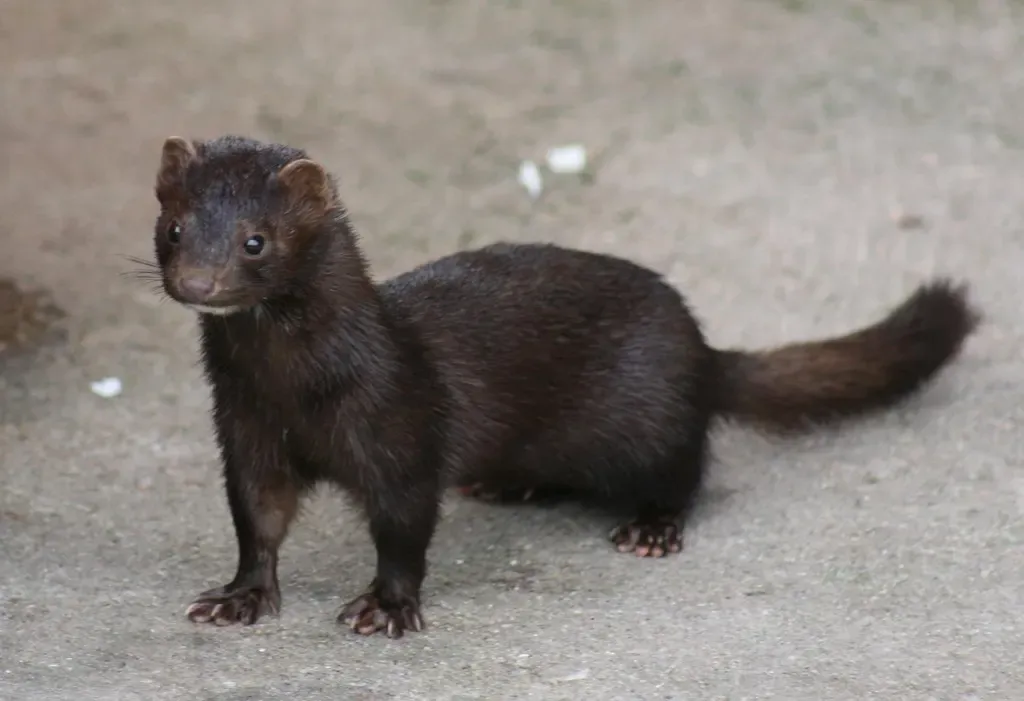
Larger and stouter than the stoats and weasels, approaching a marten in build, with a uniformly bushy, slightly tapering tail rather than a slender one with a bushy tip. Males measure 34–45 cm in body length and females 31–37.5 cm, with a tail of 15–25 cm in males; winter weights run 500–1,580 g for males and 400–780 g for females. Svenska Jägareförbundet gives Swedish mink as 0.5–1.5 kg, with a body of 30–54 cm and a tail of 14–21 cm. The feet are broad with webbed toes. The coat is brown to black, evenly coloured with the underside only slightly lighter, and usually a shade darker in winter; the chin and lower lip are white. Thick underfur and oily guard hairs make it water-resistant. It moults in spring and autumn and never turns white. Animals kept in captivity tend to develop irregular white patches underneath.
Chapter 03
Behaviour
A carnivore of rodents, fish, crustaceans, amphibians and birds, which it kills with a bite to the back of the head or neck, leaving canine punctures 9–11 mm apart. It drowns birds as large as gulls and cormorants and is a formidable predator of muskrats, chasing them under water and into their own burrows. In Britain rabbits are the commonest prey where they are plentiful, with ducks, moorhens and coots taken on lakes and rivers. In Sweden it is an important predator of ground-nesting birds, their eggs and young, and of crayfish, and it may cache food. Territories are held by single animals and follow the water; a male's home range stretches up to 3 km along a watercourse, is scent-marked and defended, and holds two to five day dens. The mink does not form pairs: in Sweden mating begins in March, the male mates with several females, and after a delayed implantation three to six young are born in early May. They become independent in July and August, when many young animals move away to new areas.
Chapter 04
Hunting
Before farming took over, the mink was among the most often trapped furbearers: it does not hibernate and could be caught nightly even in the far north, and it was trapped from early November to early April, when the pelt was prime. Native American trappers dragged a bait around ground laid with traps, or set traps scented with muskrat and female mink musk on disused muskrat dens by the water. In Britain mink were hunted with packs of hounds until 2005. In Sweden mink, like the other alien game species, may be hunted all year round to prevent the damage they cause, under the Hunting Ordinance; dogs may be used on it from 1 August to 15 April, and below ground all year. Svenska Jägareförbundet carries out several mink management assignments for different authorities every year.
Sources
Sources: American mink — Wikipedia, Svenska Jägareförbundet: Mink — artpresentation, Svenska Jägareförbundet: Amerikansk mink (Neovison vison), Jaktförordning (1987:905) — Sveriges riksdag — read 2026-10-29
Cross-reference
Related species
Its closest relatives in the compendium, nearest kinship first.
Predators & furbearers
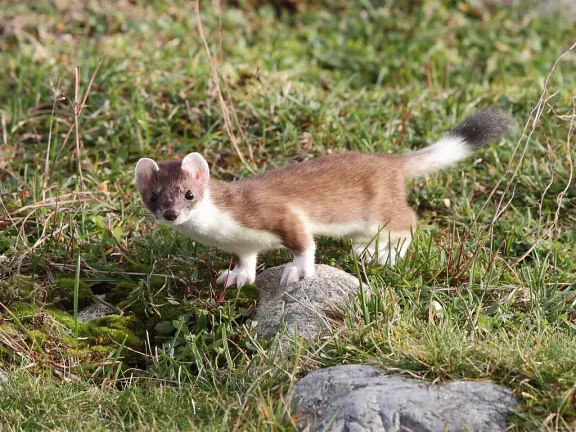
Stoat
Mustela erminea
Same genus (Mustela)
Predators & furbearers
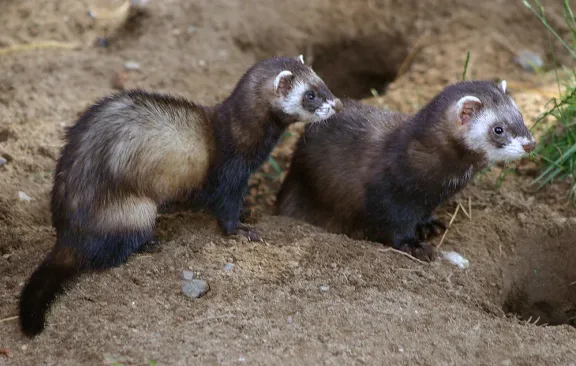
European polecat
Mustela putorius
Same genus (Mustela)
Predators & furbearers
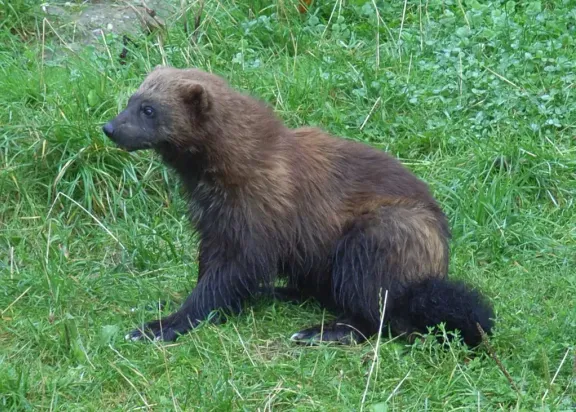
Wolverine
Gulo gulo
Same family (Mustelidae)
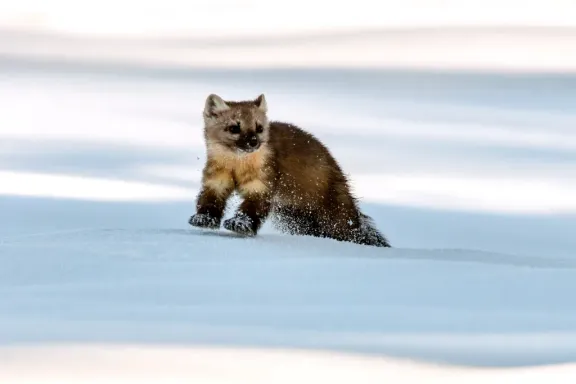
Predators & furbearers
American marten
Martes americana
Same family (Mustelidae)
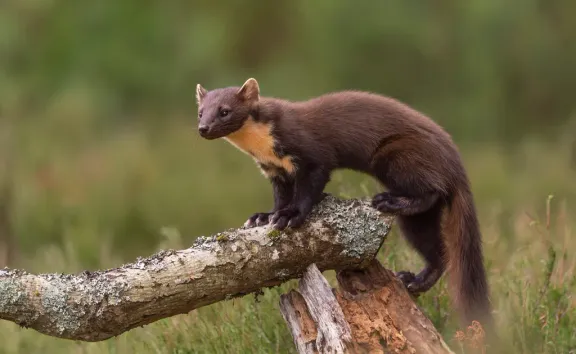
Predators & furbearers
European pine marten
Martes martes
Same family (Mustelidae)
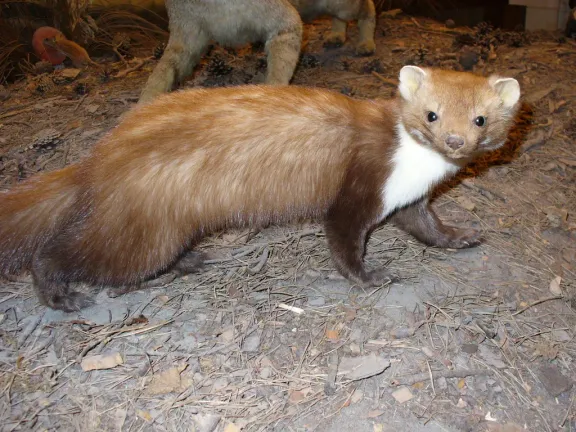
Predators & furbearers
Stone marten
Martes foina
Same family (Mustelidae)