Predators & furbearers
Stone marten
Martes foina
- Group
- Predators & furbearers
- Size class
- Small (under 10 kg)
- Family
- Mustelidae
Range
- Europe
- Asia
Habitat
- Farmland
Range
Countries it is found in
58 countries
- Afghanistan
- Albania
- Andorra
- Armenia
- Austria
- Azerbaijan
- Belarus
- Belgium
- Bhutan
- Bosnia & Herzegovina
- Bulgaria
- China
- Croatia
- Czechia
- Denmark
- Estonia
- France
- Georgia
- Germany
- Greece
- Hungary
- India
- Iran
- Iraq
Range from:ASM Mammal Diversity Database, GBIF occurrence records — read 2026-08-05
Chapter 01
Overview
The stone marten (Martes foina), also called the beech, house or white-breasted marten, is native to much of Europe and Central Asia, from Spain and Portugal east to the Altai, the Tien Shan and northwest China, and south to Afghanistan, Pakistan, India, Nepal, Bhutan and northern Burma. Escaped fur-farm animals have established it in Wisconsin. The IUCN lists it as least concern. Where the pine marten is a forest specialist, the stone marten is an adaptable generalist of open and wooded country, and it lives readily alongside people — on farmland, in villages and in towns. Within Europe it is absent from the British Isles, most of Scandinavia, Finland and the northern Baltic, and there is no evidence it ever occurred naturally in Sweden. The first confirmed Swedish record is from 2018, when one was shot in a henhouse at Fjälkinge in Skåne; further searching turned up finds in the same area going back to 2014, all within a small area around Bromölla in northeastern Skåne. It most likely reached Sweden by hitching a ride on a lorry or similar from Central Europe or Denmark.
Chapter 02
Identification
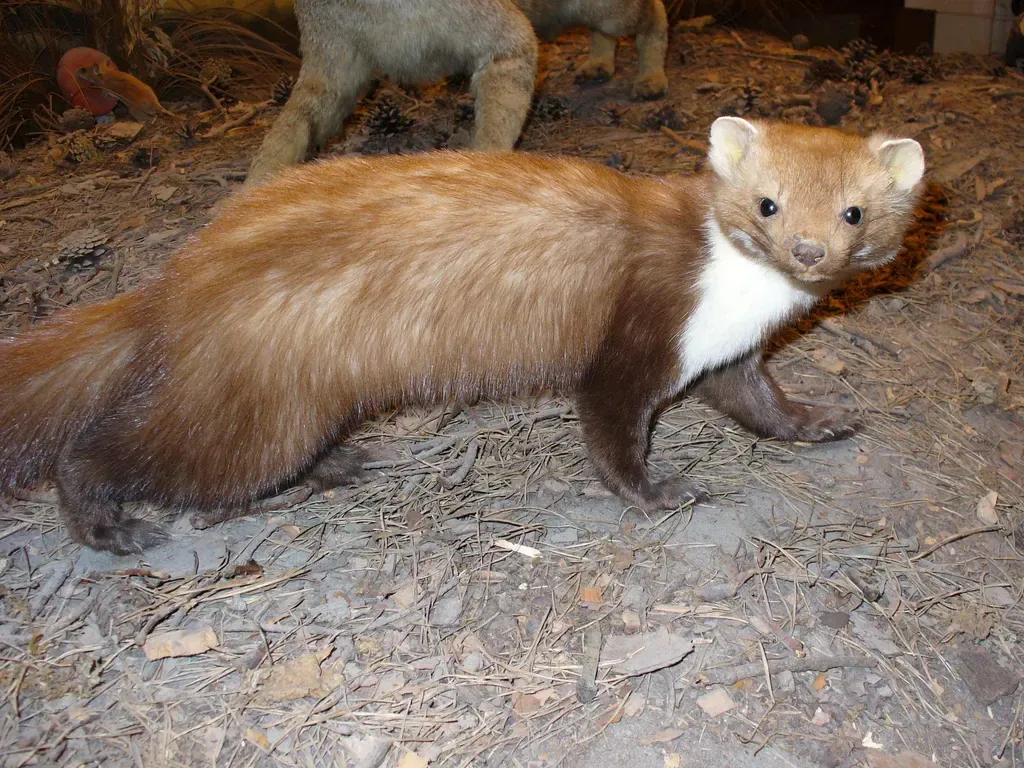
Much like the pine marten, but with a somewhat longer tail, a more elongated, angular head and shorter, rounder, more widely spaced ears. Three things tell it apart: the throat patch is always white, large and forked backwards towards the forelegs; the nose is light peach or grey rather than black; and the feet are less densely furred, so the pads stay visible even in winter. Its shorter limbs give it a creeping, polecat-like gait rather than the pine marten's bounds. Males measure 430–590 mm with a tail of 250–320 mm, females 380–470 mm with a tail of 230–275 mm. Males weigh 1.7–1.8 kg in winter and 2–2.1 kg in summer, females 1.1–1.3 kg and 1.4–1.5 kg. The fur is coarser and lighter than the pine marten's, with whitish rather than greyish underfur and a dark-brown tail.
Chapter 03
Behaviour
Mainly crepuscular and nocturnal, especially active on moonlit nights, and more of a ground animal than the pine marten, though a skilled climber and swimmer. It does not dig burrows; it dens in rock fissures, among the stones of screes and in buildings, which in towns it uses almost exclusively, especially in winter. A marten in northeastern Spain kept a home range of 52.5 ha. Its diet holds far more plant food than the pine marten's — cherries, apples, pears, plums, grapes and rowan, predominating in winter — along with rats, mice, small birds and their nests. Some individuals become specialist poultry raiders. Mating falls in June and July, often on house roofs; with delayed implantation the litter of three to seven kits is born in late March or early April. Since the mid-1970s it has been known for chewing cables and hoses in cars, a habit that peaks in spring when young martens are exploring.
Chapter 04
Hunting
Its pelt is worth less than the pine marten's or sable's, yet where better furs are scarce it still has local value to hunters; in the Soviet Union it was caught in the Caucasus, Crimea and Central Asia. It is taken in jaw traps or, alive, in cage traps. Shooting is inefficient, and trailing with dogs only works when the marten can be cornered in a hollow tree. In Sweden it is managed as an invasive alien species. In 2021 Naturvårdsverket commissioned Svenska Jägareförbundet to cull reported stone martens near the known population, and a pilot project in 2022–2023 searched actively with bait sites and trail cameras to contain the population and eradicate it from Sweden. By the end of 2023 the project knew of 69 dead stone martens, 57 of them culled by the project. The holder of the hunting right may hunt stone marten all year round; the Hunting Ordinance lists it among the alien species that may be hunted 1 July to 30 June to prevent damage and allows dogs to be used on it underground all year. Sightings, signs such as chewed cables and shot animals should be reported to Jägareförbundet.
Field data
Tracks
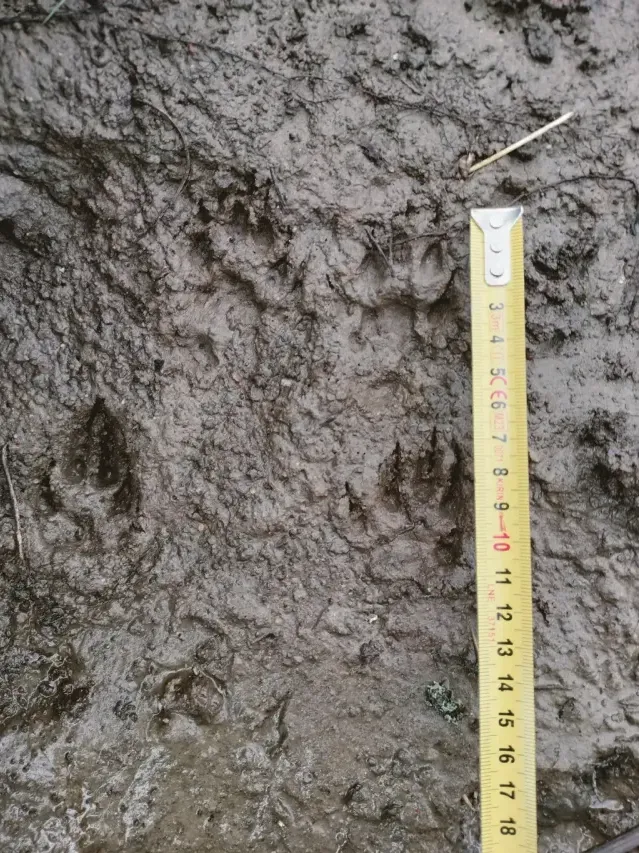
A photograph of real sign left by Stone marten. Prints vary with gait, ground and how long they have been there — treat this as one example, not a template.
Track photo:Bartosz SarnowskiCC BY
Sources
Sources: Beech marten — Wikipedia, Stenmård — Wikipedia (sv), Svenska Jägareförbundet: Stenmård (Martes foina), Jaktförordning (1987:905) — Sveriges riksdag — read 2026-10-29
Cross-reference
Related species
Its closest relatives in the compendium, nearest kinship first.

Predators & furbearers
European pine marten
Martes martes
Same genus (Martes)

Predators & furbearers
American marten
Martes americana
Same genus (Martes)

Predators & furbearers
Wolverine
Gulo gulo
Same subfamily (Guloninae)

Predators & furbearers
Fisher
Pekania pennanti
Same subfamily (Guloninae)

Predators & furbearers
European badger
Meles meles
Same family (Mustelidae)

Predators & furbearers
European polecat
Mustela putorius
Same family (Mustelidae)