Upland birds
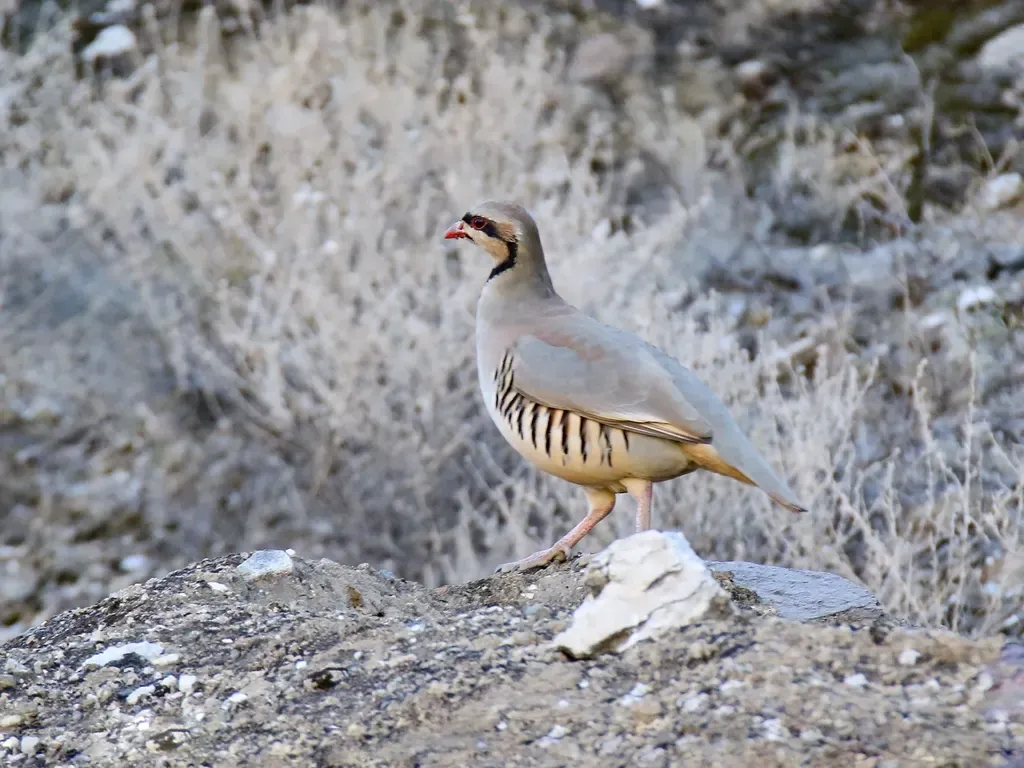
Chukar partridge
Alectoris chukar
- Group
- Upland birds
- Size class
- Small (under 10 kg)
- Family
- Phasianidae
Range
- Asia
- North America
- Europe
- Oceania
Habitat
- Mountain
- Desert
Range
Countries it is found in
43 countries
- Afghanistan
- Armenia
- Azerbaijan
- Bahamas
- Bahrain
- Bulgaria
- Canada
- China
- Cyprus
- Egypt
- France
- Georgia
- Greece
- India
- Iran
- Iraq
- Israel
- Italy
- Jordan
- Kazakhstan
- Kuwait
- Kyrgyzstan
- Lebanon
- Malta
Range from:Wikipedia country bird lists — read 2026-08-05
Chapter 01
Overview
The chukar (Alectoris chukar) is a Palearctic upland gamebird of the pheasant family, native from south-easternmost Europe — Bulgaria and Greece — across the Middle East and Central Asia to the western Himalayas and Mongolia, with 14 recognised subspecies. It has been treated as one species with the rock partridge, which replaces it to the west, and forms a superspecies with it and Philby's and Przevalski's partridges. It lives on rocky open hillsides with grass, scattered scrub or cultivation, from 400 m below sea level at the Dead Sea to 2,000–4,000 m further east, and avoids humid, rainy country. Feral populations established after introductions as a gamebird live in the western United States, Canada, Chile, Argentina, New Zealand and Hawaii, and on Robben Island in South Africa since 1964.
Chapter 02
Identification
A rotund partridge 32–35 cm long, with a light brown back, grey breast and buff belly, boldly black-and-white barred flanks, red legs and a coral-red bill. A black band runs from the forehead through the eye and down to form a necklace around the throat. Sexes are alike; the female is slightly smaller and lacks the spur. It is browner on the back than the rock partridge and has a yellowish tinge to the foreneck; the sharply defined gorget separates it from the red-legged partridge, and the Barbary partridge has a reddish-brown collar. The name comes from the song, a noisy chuck-chuck-chukar-chukar.
Chapter 03
Behaviour
Outside the breeding season chukars live in coveys of ten or more birds, up to fifty, coming down into valleys to feed in fields in winter. They call often, especially morning and evening; the 'rallying call' draws an answer when played back and has been used in surveys, though not very reliably. Disturbed, they run rather than fly, and when they must they fly a short way, often downhill, calling as soon as they land. Pairs form in summer, when cocks become very pugnacious. Males are monogamous. Seven to fourteen eggs are laid in a scrape sheltered by ferns, bushes or an overhanging rock and hatch after 23–25 days. In Utah birds foraged over about 2.6 km² and travelled up to 4.8 km for water in the dry season.
Chapter 04
Hunting
The chukar has been introduced widely as a gamebird, and in the United States it is hunted across the dry, rocky Columbia Basin, especially along the Snake River in Washington and Oregon. Its numbers are relatively unaffected by hunting; they depend mostly on the weather in the breeding season. British sportsmen in India thought it good sport but not particularly good eating. Its fast flight and its ability to carry on some distance after being shot made birds hard to recover without retrievers. In Kashmir, when snow covers the higher ground in cold winters, people have been known to tire the birds out to catch them. Because chukars hybridise readily with red-legged partridges, breeding and releasing captive hybrids is banned in several countries, the United Kingdom among them.
Field data
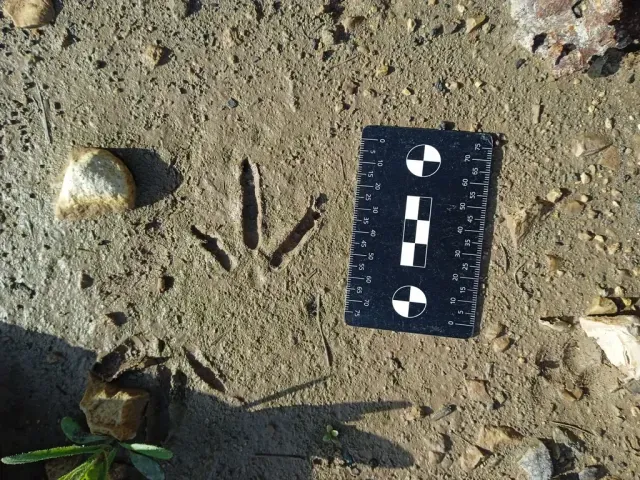
Tracks
A photograph of real sign left by Chukar partridge. Prints vary with gait, ground and how long they have been there — treat this as one example, not a template.
Track photo:yelena_antipovaCC BY
Sources
Sources: Chukar partridge — Wikipedia, Berghöna — Wikipedia — read 2026-10-29
Cross-reference
Related species
Its closest relatives in the compendium, nearest kinship first.
Upland birds
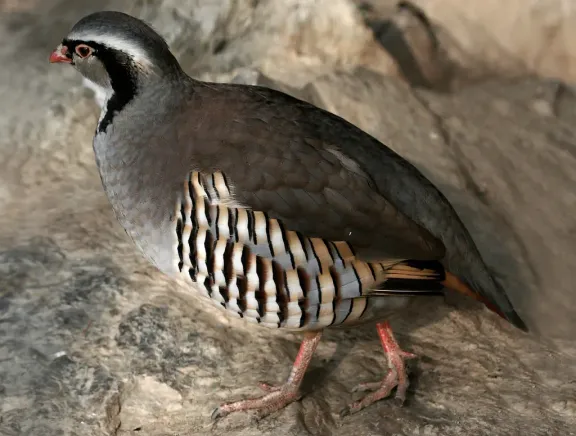
Rock partridge
Alectoris graeca
Same genus (Alectoris)
Upland birds
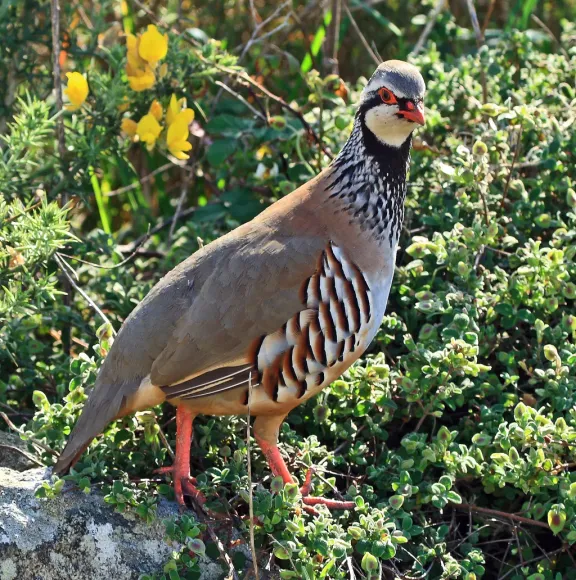
Red-legged partridge
Alectoris rufa
Same genus (Alectoris)
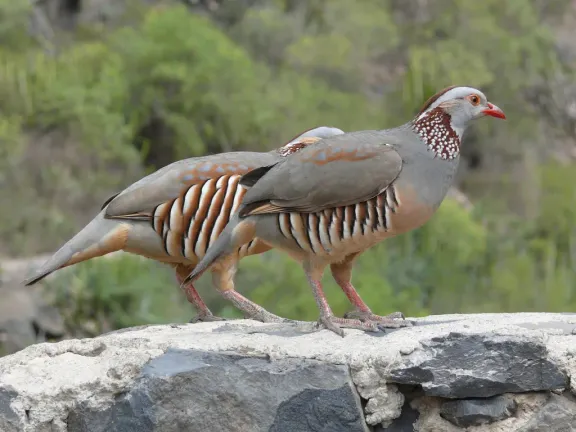
Upland birds
Barbary partridge
Alectoris barbara
Same genus (Alectoris)
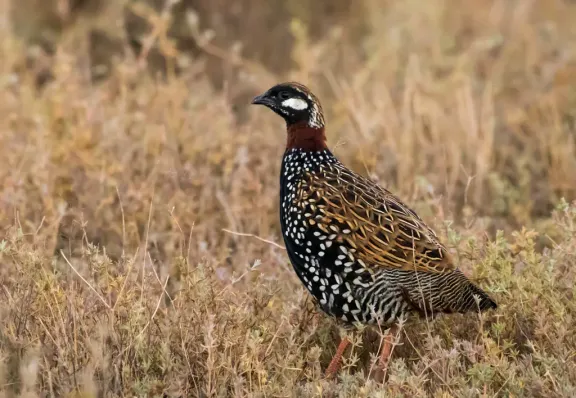
Upland birds
Black francolin
Francolinus francolinus
Same subfamily (Perdicinae)
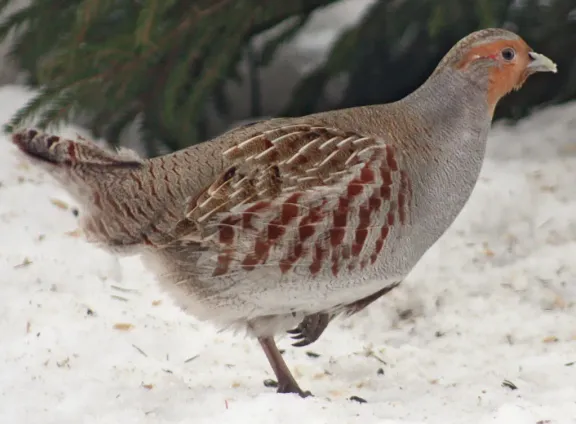
Upland birds
Grey partridge
Perdix perdix
Same subfamily (Perdicinae)
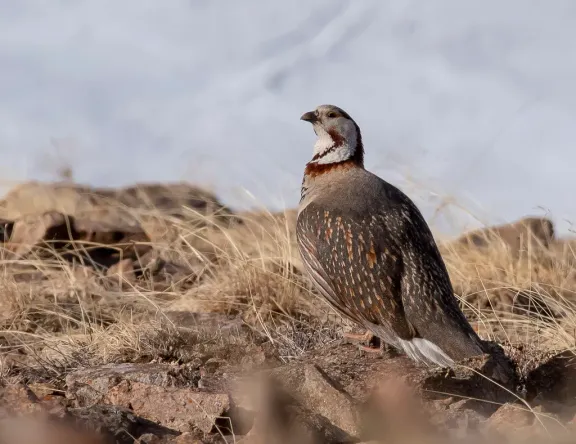
Upland birds
Himalayan snowcock
Tetraogallus himalayensis
Same subfamily (Perdicinae)