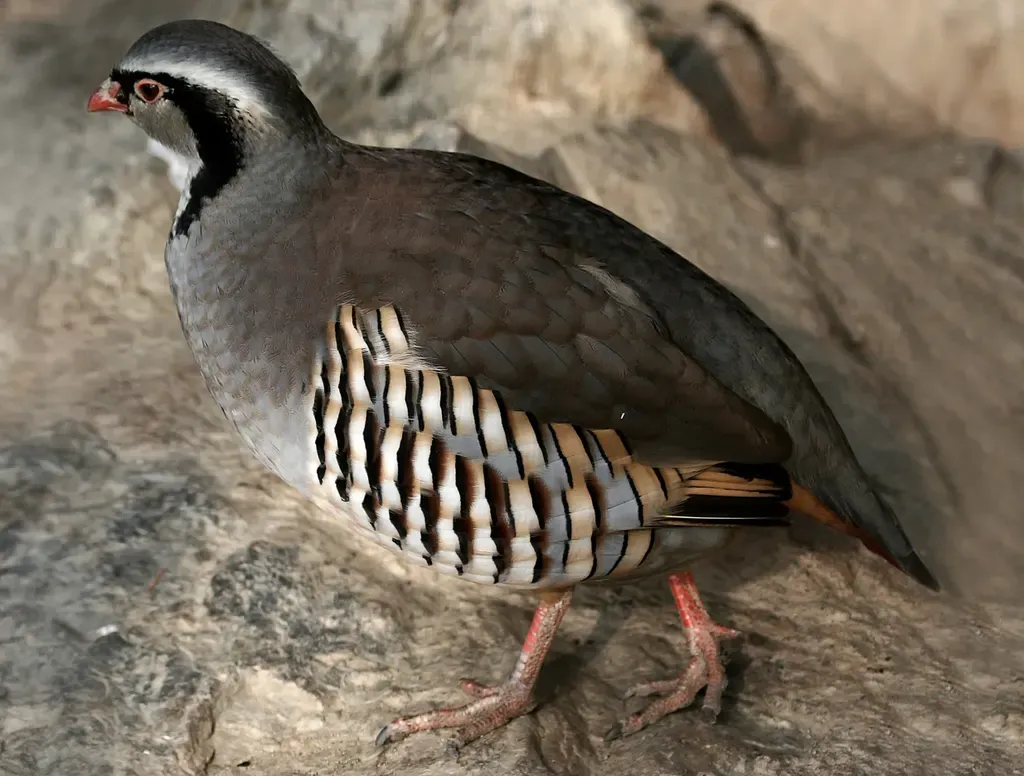
Upland birds
Rock partridge
Alectoris graeca
- Group
- Upland birds
- Size class
- Small (under 10 kg)
- Family
- Phasianidae
Range
- Europe
Habitat
- Mountain
Range
Countries it is found in
16 countries
- Albania
- Austria
- Bosnia & Herzegovina
- Bulgaria
- Croatia
- France
- Germany
- Greece
- Italy
- Kyrgyzstan
- Monaco
- Montenegro
- North Macedonia
- Serbia
- Slovenia
- Switzerland
Range from:Wikipedia country bird lists — read 2026-08-05
Chapter 01
Overview
The rock partridge (Alectoris graeca) is a gamebird of the pheasant family native to the mountains of southern Europe, mainly the Alps, with further populations in the Apennines, the Balkans and Sicily. It forms a superspecies with the chukar, Przevalski's and Philby's partridges; the red-legged and Barbary partridges, with their spotted neck collars, are slightly more distant relatives. Four subspecies are recognised, and the Sicilian A. g. whitakeri has been proposed as a species of its own. The world population is thought to be 41,800–73,400 pairs. It is declining through habitat loss and over-hunting, the IUCN lists it as near threatened, and the Sicilian population is thought especially vulnerable.
Chapter 02
Identification
A rotund partridge, 33–36 cm long, with a light brown back, grey breast and buff belly, a white face and throat framed by a black gorget, rufous-barred flanks and red legs. It is very like the chukar, but greyer on the back and white rather than yellowish on the foreneck; the sharply defined gorget separates it from the red-legged partridge, whose collar breaks up into streaks. The song is a noisy ga-ga-ga-ga-chakera-chakera-chakera. The names are a trap: in Dutch, German and French this species is literally 'rock partridge', while other Alectoris are 'stone partridge', and in the United States 'rock partridge' has been used for several Alectoris species and hybrids alike.
Chapter 03
Behaviour
A resident breeder of dry, open and often hilly country, it nests on stony alpine slopes with scrub and bushes, mostly between 1,000 and 2,000 m, though in Sicily and Greece it comes down almost to sea level. When disturbed it would rather run than fly, and if it must fly it goes a short distance on rounded wings. The nest is a scantily lined scrape in the ground holding 5–21 eggs. Food is a wide variety of seeds and some insects.
Chapter 04
Hunting
Over-hunting is one of the two causes named for the decline of the rock partridge, alongside habitat loss. It has been introduced as a gamebird in North America, the United Kingdom, New Zealand and Russia, and in those places, and in south-eastern France where red-legged partridges are released, hybrids with the chukar and the red-legged partridge are usually found. The international trade in these birds for sport, aviaries and meat has led to their common and scientific names being misapplied.
Field data
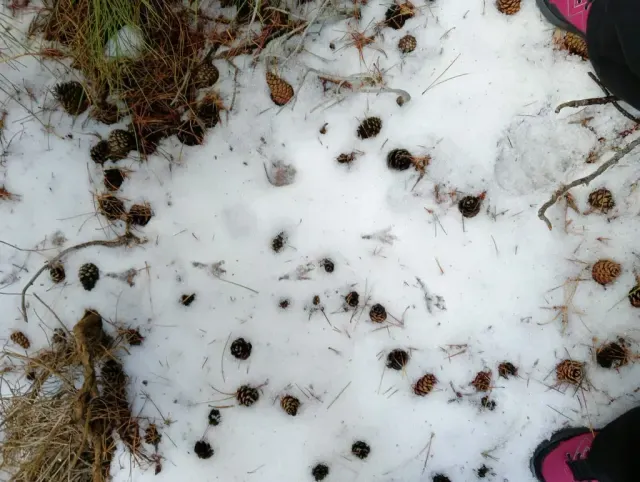
Tracks
A photograph of real sign left by Rock partridge. Prints vary with gait, ground and how long they have been there — treat this as one example, not a template.
Track photo:Leonardo RapisardaCC BY
Sources
Sources: Rock partridge — Wikipedia, Stenhöna — Wikipedia — read 2026-10-29
Cross-reference
Related species
Its closest relatives in the compendium, nearest kinship first.
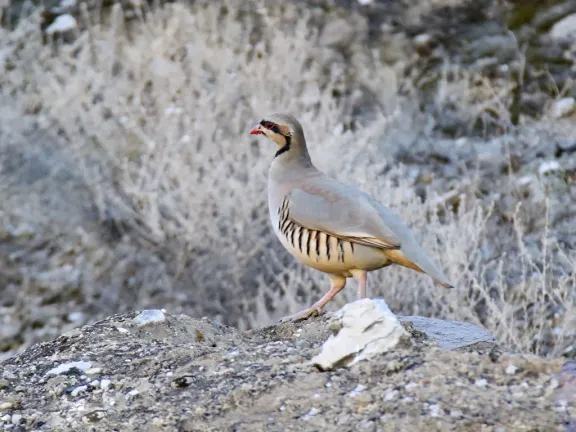
Upland birds
Chukar partridge
Alectoris chukar
Same genus (Alectoris)
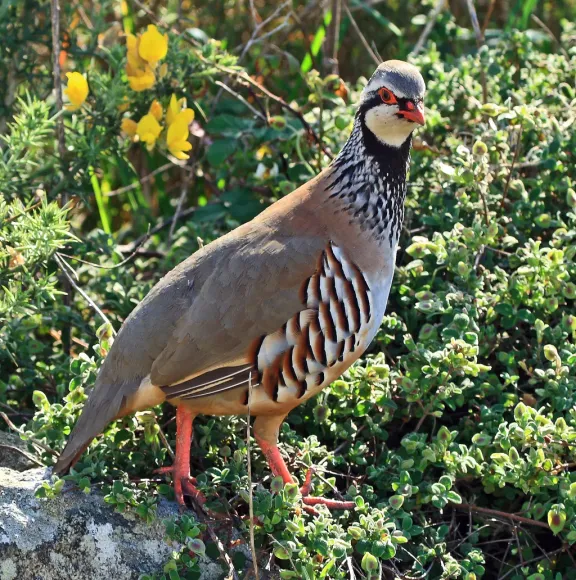
Upland birds
Red-legged partridge
Alectoris rufa
Same genus (Alectoris)
Upland birds
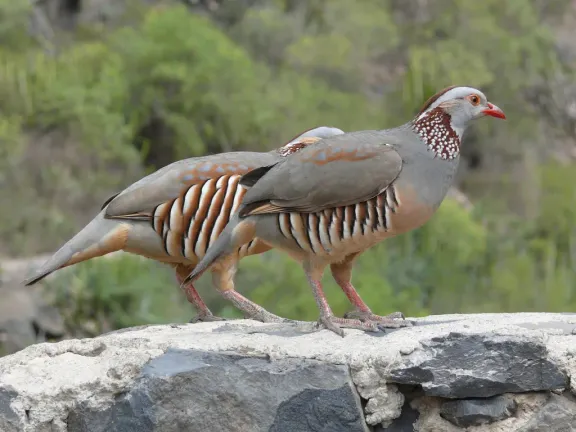
Barbary partridge
Alectoris barbara
Same genus (Alectoris)
Upland birds
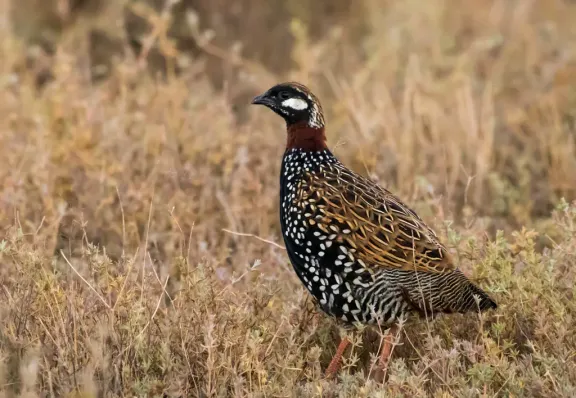
Black francolin
Francolinus francolinus
Same subfamily (Perdicinae)
Upland birds
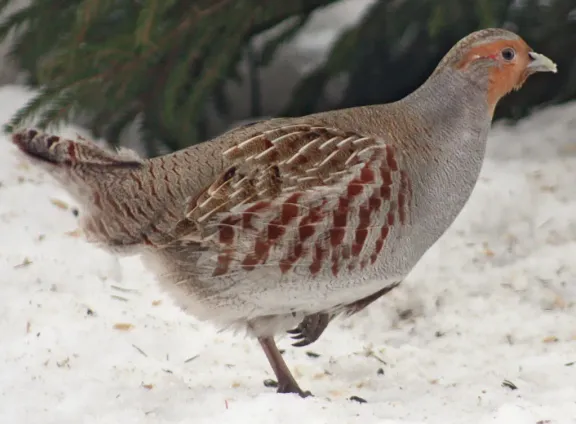
Grey partridge
Perdix perdix
Same subfamily (Perdicinae)
Upland birds
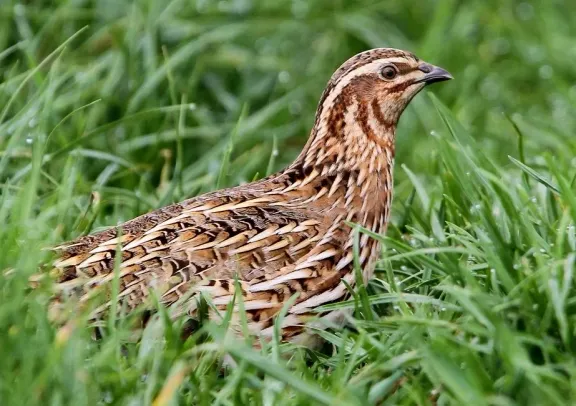
Common quail
Coturnix coturnix
Same subfamily (Perdicinae)