Germany · 1935–1945
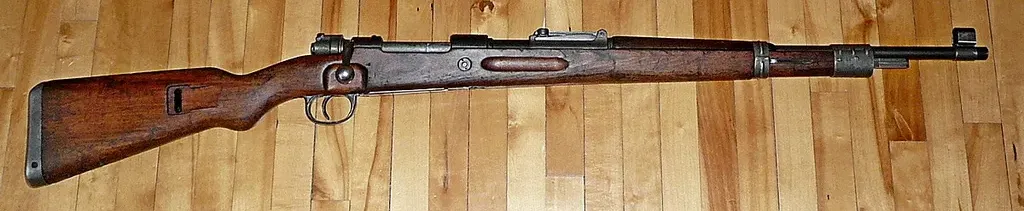
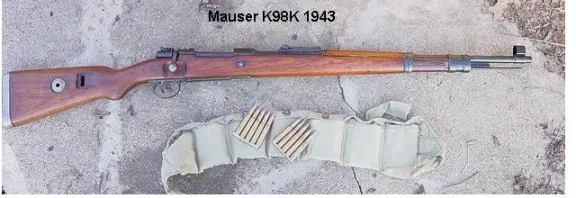
Mauser K98k sporter
- Military surplus
Specifications
- Maker
- Mauser
- Type
- Rifle
- Action
- Bolt action
- Era
- Classic (1890–1945)
- Produced
- 1935–1945
- Magazine
- 5 rounds
- Swedish class
- 1
On a common factory load. Check the box against Naturvårdsverket's figures.
Chambered in
- 8×57 IS
Stock
- Wood
What it is worth
Value unknown
No published price was found for this model. Rather than estimate one from a comparable gun, the compendium leaves it blank.
Chapter 01
Overview
The Wehrmacht adopted the Karabiner 98k on 21 June 1935, and it stayed the German army’s most common small arm until May 1945, built by Mauser and at least eight other plants, Sauer & Sohn in Suhl among them. What a hunter meets is the aftermath: military actions converted into civilian hunting rifles.
Chapter 02
How it works
A controlled-feed Mauser 98 action with a 600 mm barrel in 7.92×57, a five-round internal magazine filled from a stripper clip or one at a time, and a turned-down bolt handle in place of the Gewehr 98’s straight one. The safety is the 98’s three-position lever.
Chapter 03
Variants
After the war Schultz & Larsen in Otterup began its post-war hunting and target rifles on components from Kar 98ks the occupying forces left behind in Denmark. Kongsberg likewise built its M59 and M67 target and sniper rifles on 98k actions German forces had left in 1945.
Chapter 04
In the field
Scoping one is the classic job: a sight mounted low over the receiver leaves no room to work the bolt handle or the three-position safety. In Sweden the ammunition, not the rifle, decides the class — loaded with full-metal-jacket bullets, even an 8×57 is legal only for class 3 game.
Sources
Written from: Karabiner 98k — Wikipedia, Karabiner 98k — Wikipedia (de), Schultz & Larsen — Wikipedia, Klassifikation av jaktvapen i Sverige — Wikipedia (sv) — read 2026-10-29
Cross-reference
Similar guns
Rifle
Mauser M03
2003–2018 · Bolt action
Value unknown
Rifle
Mauser M12
2012– · Bolt action
Value unknown
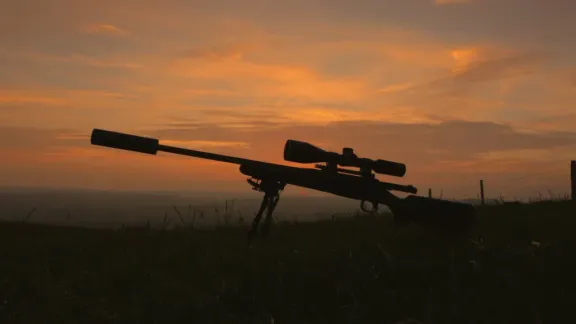
Rifle
Mauser M18
2017– · Bolt action
$1,155–$1,320 · 2026
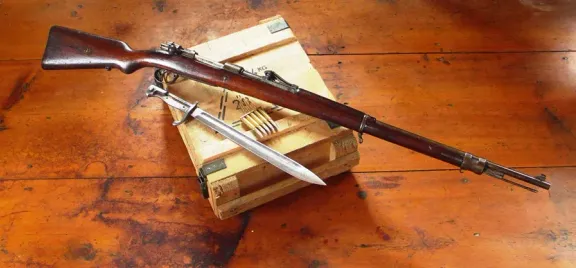
Rifle
Mauser M98
1898– · Bolt action
$572 · 2026
Rifle
Anschütz Model 1416
1980– · Bolt action
$615–$1,120 · 2026
Rifle
Anschütz Model 1771
2015– · Bolt action
Value unknown