Predators & furbearers
Asiatic black bear
Ursus thibetanus
- Group
- Predators & furbearers
- Size class
- Large (70–300 kg)
- Family
- Ursidae
Range
- Asia
Habitat
- Forest
- Mountain
Range
Countries it is found in
17 countries
- Afghanistan
- Bangladesh
- Bhutan
- Cambodia
- China
- India
- Iran
- Japan
- Laos
- Nepal
- North Korea
- Pakistan
- Russia
- South Korea
- Taiwan
- Thailand
- Vietnam
Range from:ASM Mammal Diversity Database — read 2026-08-05
Chapter 01
Overview
The Asian black bear (Ursus thibetanus), also called the Asiatic black bear, moon bear or white-chested bear, is a medium-sized, largely tree-dwelling bear of Asia. It ranges very patchily from southeastern Iran through Afghanistan, Pakistan and the Himalayan foothills to mainland Southeast Asia, China, Taiwan, the Korean Peninsula, the southern Russian Far East and the Japanese islands of Honshū and Shikoku; in the Pleistocene it reached as far west as Iberia. It lives in deciduous, mixed and thornbrush forest, in summer up to about 3,500 m in the Himalayas and in winter below 1,500 m; in Japan it also occurs at sea level. The IUCN lists it as vulnerable, threatened by deforestation and by poaching for paws, gall bladders and cubs for traditional medicine; bile has been prized in Chinese medicine for some 3,000 years, and in 2008 over 7,000 were thought to be kept on bile farms. Numbers are poorly known: China's government estimate is 28,000, India's is 7–9,000 and Pakistan's about 1,000. Japan is the exception — conservation policy and an ageing, shrinking body of hunters took the Japanese population from about 15,000 in 2012 to some 44,000 in 2023.
Chapter 02
Identification
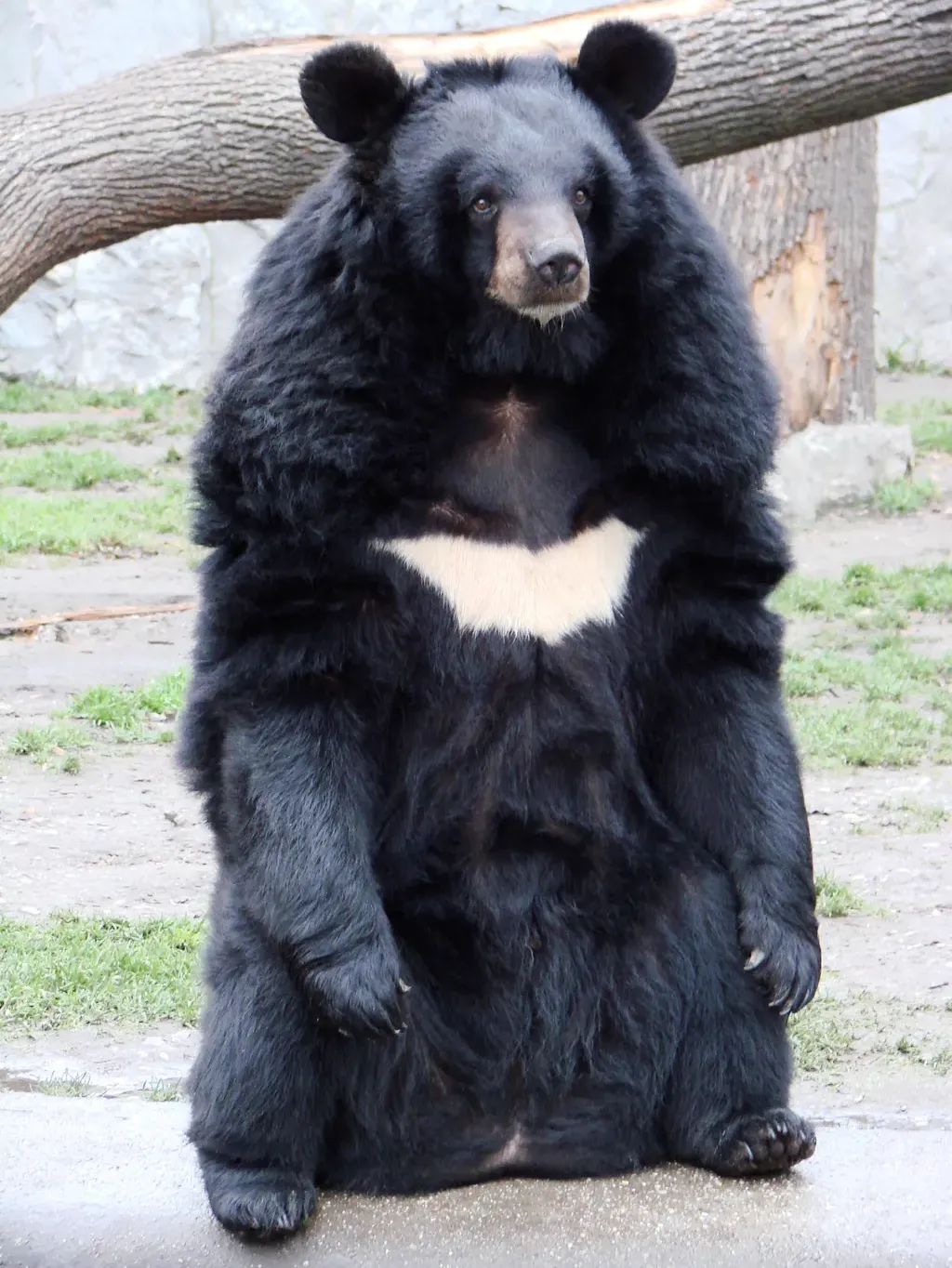
A black bear with a light brown muzzle and a distinct whitish or creamy patch on the chest, often V-shaped; a few animals are brownish. The longer hair around the neck gives the Swedish name, collar bear. The bell-shaped ears are proportionately longer than other bears' and stick out sideways, and the tail is short, around 11 cm. Adults stand 70–100 cm at the shoulder and measure 120–190 cm. Males weigh 60–200 kg, averaging about 135 kg; females 40–125 kg, large ones up to 140 kg. It resembles a lighter, smaller brown bear, with larger, more mobile lips and nose and a low, short sagittal crest. A powerful upper body and comparatively weak hind legs make it a strong climber, and it is the most bipedal of the bears, able to walk upright for over 400 m. The hooked claws are 30–45 mm on the forefeet and 18–36 mm behind.
Chapter 03
Behaviour
Mainly diurnal, the bear turns nocturnal near people. It climbs to feed, rest, sun itself and escape, breaking branches beneath it as it eats so that many trees in its range carry nest-like platforms. Most do not hibernate, but in the colder north they den from about November to March in hollow trees, caves, holes or sunny slopes, and nearly all pregnant females den. With enough food a bear may stay within 1–2 km². Its calls range from grunts, whines and roars to loud hisses as a threat, a tongue-clicking "tut tut" on approaching other bears and clucking in courtship. It is omnivorous: insects and larvae, honey, carrion, acorns, pine nuts, hazelnuts, cherries, grapes, fruit, grasses, roots and grain, with acorns the year-round staple in Japan. It also kills ungulates fairly regularly — muntjac, serow, takin, wild boar, even adult water buffalo, by breaking the neck — and takes livestock. In Sikhote-Alin mating runs from mid-June to mid-August; implantation is delayed, and after 200–240 days usually two cubs are born in a cave or hollow tree in winter, staying with their mother for two to three years.
Chapter 04
Hunting
In British India black bears were stalked in the forests around the Kashmir valley — with more care than brown bears on the open hills, since the black bear sees and hears better — or driven out of small patches of forest by beaters. They were seldom hunted for sport, as the fur was poor and the bears easily shot in trees, but wounded ones were known to be extremely dangerous. The Asian black bear is generally more aggressive towards people than other Eurasian and American bears, and sudden close encounters cause most attacks. Today it is legally hunted for sport only in Japan and Russia, according to Wikipedia, which gives 75–100 bears taken legally in Russia each year against a reported 500 illegally; the same article lists it in Russia's Red Data Book, under special protection with hunting prohibited, and protected since 1983. In Japan, where matagi hunters traditionally drove bears upslope to a waiting gun in spring or late autumn, a management manual of 2000 capped the annual cull; as the recovered population brought a sharp rise in attacks from around 2023 — a record in 2025 — the government in 2024 revised its plan towards active population management through hunting. Elsewhere it is protected: under China's wildlife protection law hunting without a permit is severely punished; in India it is a Schedule I species and on CITES Appendix I; Vietnam has prohibited its hunting and export since 1989; Taiwan lists its bear as endangered; and the Korean government has designated it Natural Monument No. 329.
Field data
Tracks
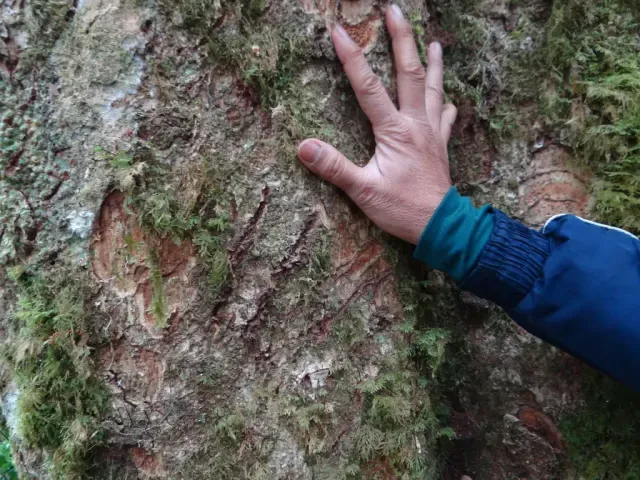
A photograph of real sign left by Asiatic black bear. Prints vary with gait, ground and how long they have been there — treat this as one example, not a template.
Track photo:呂一起(Lyu yi-chi)CC BY
On the table
Meat & cooking
Table grade 1 of 51/5
- Sold as meat in a legal market
- Has a named traditional dish
- Published way to handle and cook it
- Eaten in more than one country
- No known health advisory
Before you eat it: Bear meat can carry Trichinella, a parasite potentially lethal to humans, and must be cooked thoroughly. Among the Rukai of Taiwan, who may hunt the bear, children are traditionally forbidden to eat its meat and it may not be brought into the home.
Sources
Sources: Asian black bear — Wikipedia, Kragbjörn — Wikipedia (sv), Bear hunting — Wikipedia — read 2026-10-29
Cross-reference
Related species
Its closest relatives in the compendium, nearest kinship first.
Predators & furbearers
Brown bear
Ursus arctos
Same genus (Ursus)
Predators & furbearers
American black bear
Ursus americanus
Same genus (Ursus)
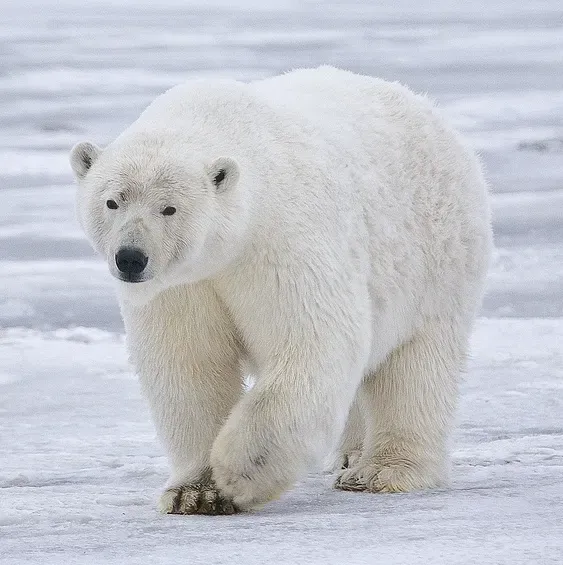
Predators & furbearers
Polar bear
Ursus maritimus
Same genus (Ursus)
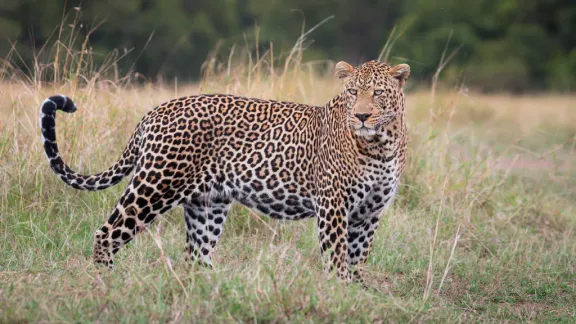
Predators & furbearers
Leopard
Panthera pardus
Same order (Carnivora)
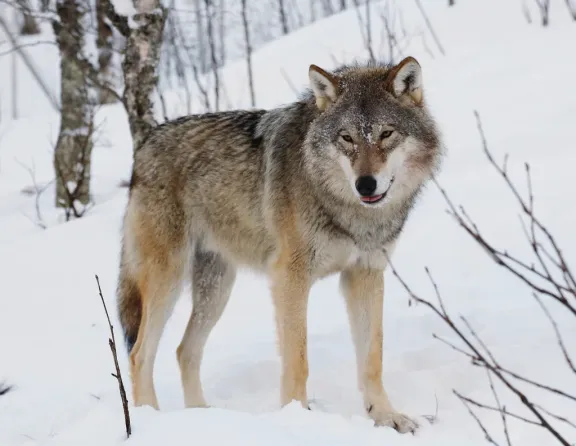
Predators & furbearers
Gray wolf
Canis lupus
Same order (Carnivora)
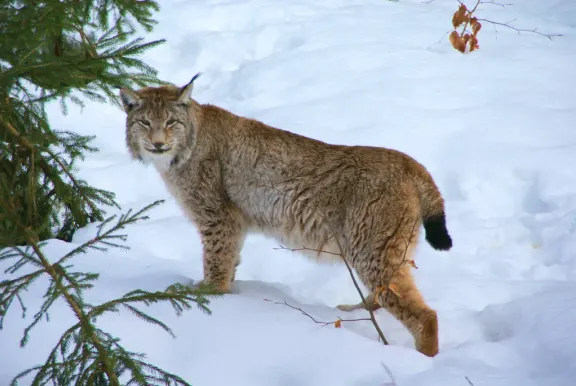
Predators & furbearers
Eurasian lynx
Lynx lynx
Same order (Carnivora)