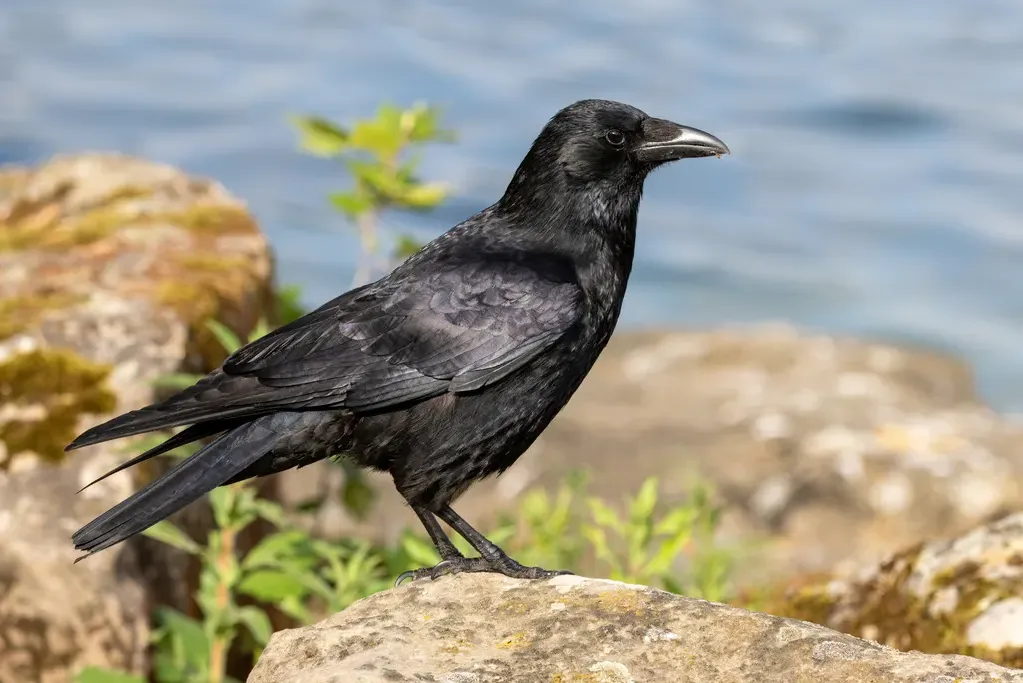
Photo:Alexis LoursCC BY 4.0
Upland birds
Carrion crow
Corvus corone
- Group
- Upland birds
- Size class
- Small (under 10 kg)
- Family
- Corvidae
Range
- Europe
Habitat
- Farmland
Range
Countries it is found in
55 countries
- Afghanistan
- Åland Islands
- Albania
- Andorra
- Armenia
- Austria
- Belgium
- Bosnia & Herzegovina
- China
- Croatia
- Cyprus
- Czechia
- Denmark
- Egypt
- Estonia
- Faroe Islands
- Finland
- France
- Georgia
- Germany
- Greece
- Guernsey
- Hungary
- Ireland
Range from:Wikipedia country bird lists, GBIF occurrence records — read 2026-08-05
Chapter 01
Overview
The carrion crow (Corvus corone) is an all-black crow of western Europe, with an eastern form, C. c. orientalis, at the other end of Eurasia. Linnaeus described it in 1758 and it still bears his name for it. Where its range meets that of the hooded crow the two hybridise; genome studies have found them almost identical, the hooded crow's grey body coming down to a tiny region of one chromosome. In Europe the carrion crow is resident from southern Scotland and England south to Iberia and east to the Elbe. In Sweden it is a rare breeding bird, mainly in Skåne, and a scarce visitor elsewhere. Since June 2025 BirdLife Sverige, following the AviList world list, again counts carrion and hooded crow as one species, kråka.
Chapter 02
Identification
A black crow 48–52 cm long, with a wingspan of 84–100 cm and a weight of 400–600 g. The plumage has a green or purple sheen, much greener than a rook's, and bill, legs and feet are black. It is told from the raven by its much smaller size and from the hooded crow by having no grey. Juveniles are browner and have blue eyes that darken with age. Telling it from a young rook, which also lacks the bare face, is hard in the field. The voice is the best guide: the crow's deep, guttural, slightly vibrating kraa is unlike any note of the rook, and its wingbeats are slower and more deliberate. A calling crow often bows its head and raises its shoulders with each caw.
Chapter 03
Behaviour
Carrion crows are largely solitary, though sociable at winter roosts, and can become tame around people, turning up in cities, parks, farmland, woods and on sea cliffs. They mob predators and competitors that enter their territory. The diet takes in carrion of every kind, insects, worms, grain, fruit, small mammals, amphibians, fish, eggs and human scraps, and crows will rob raptors and foxes of their kills. The bulky stick nest is usually in a tall tree. Three or four eggs are incubated by the female for 18–20 days, fed by the male, and the young fledge at around 29–30 days. Young from the previous year often stay to help rear the new brood.
Chapter 04
Hunting
In Sweden the hunting ordinance names kråka, the species that includes the carrion crow, and the hunting ordinance gives kaja, kråka and skata one open season: 16 July–30 April in Västernorrland, Jämtland, Västerbotten and Norrbotten, and 1 July–15 April in the rest of the country. Outside the season, bilaga 4 lets the holder of the hunting rights shoot it all year inside a facility to prevent damage, on land with agricultural crops or commercial horticulture where it is causing damage, on commission from the municipal environmental board, and at airports for flight safety. Svenska Jägareförbundet's crow-hunting feature describes the main methods: flight shooting over an eagle-owl decoy from a well-hidden hide, best on overcast, slightly windy mornings; calling crows in over a spread of at least ten crow decoys set 10–30 metres from the hide; and small crow traps with a live lockfågel, moved around the ground in spring to take territorial birds before nesting. In the United Kingdom the crow is one of the few pest birds that may legally be caught in cage traps.
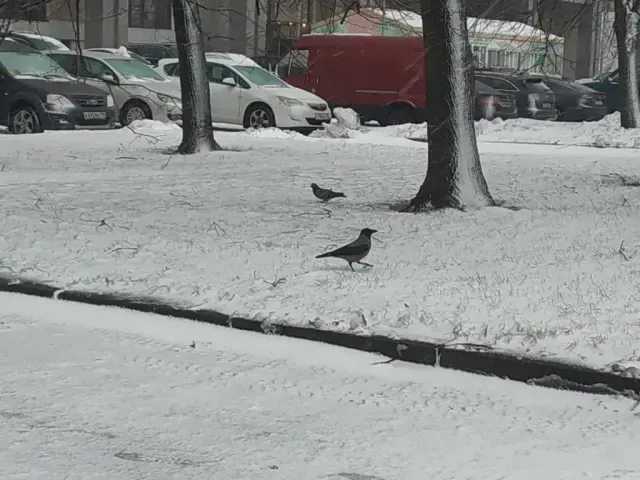
Field data
Tracks
A photograph of real sign left by Carrion crow. Prints vary with gait, ground and how long they have been there — treat this as one example, not a template.
Track photo:Kate SenatskayaCC BY
Sources
Sources: Carrion crow — Wikipedia, Svartkråka — Wikipedia (svenska), Jaktförordning (1987:905) — Sveriges riksdag, Svenska Jägareförbundet: Tema Kråkfågeljakt, Western jackdaw — Wikipedia — read 2026-10-29
Cross-reference
Related species
Its closest relatives in the compendium, nearest kinship first.
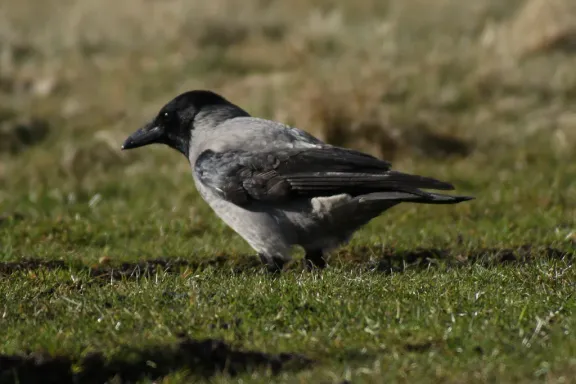
Upland birds
Hooded crow
Corvus cornix
Same genus (Corvus)
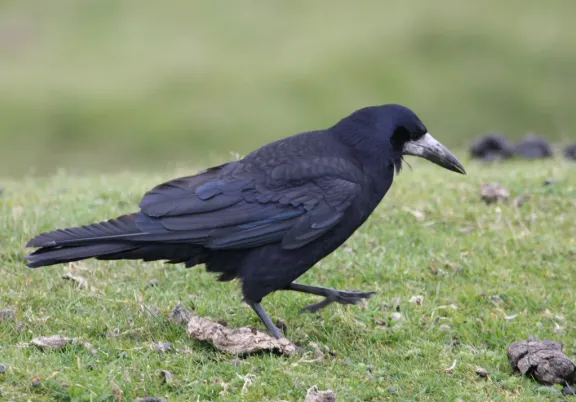
Upland birds
Rook
Corvus frugilegus
Same genus (Corvus)
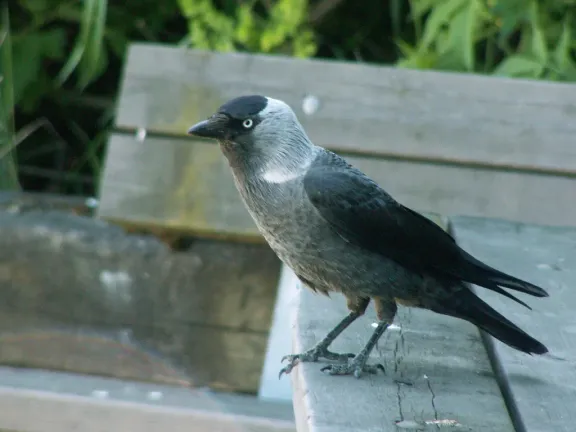
Upland birds
Western jackdaw
Coloeus monedula
Same family (Corvidae)
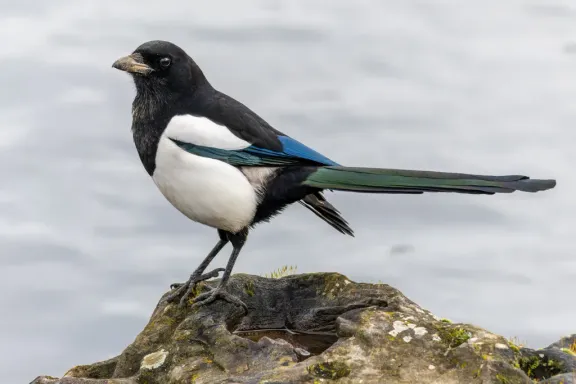
Upland birds
Eurasian magpie
Pica pica
Same family (Corvidae)
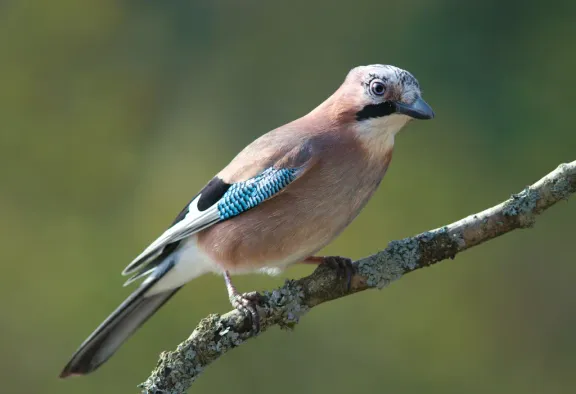
Upland birds
Eurasian jay
Garrulus glandarius
Same family (Corvidae)
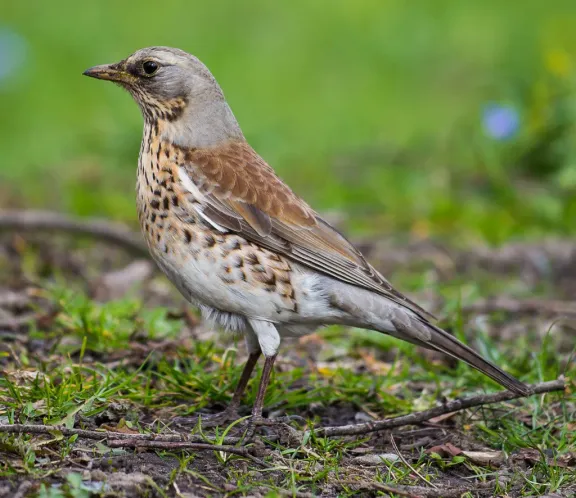
Upland birds
Fieldfare
Turdus pilaris
Same order (Passeriformes)