Big game
Alpine chamois
Rupicapra rupicapra
- Group
- Big game
- Size class
- Medium (10–70 kg)
- Family
- Bovidae
Range
- Europe
- Oceania
Habitat
- Mountain
Range
Countries it is found in
24 countries
- Albania
- Austria
- Azerbaijan
- Bosnia & Herzegovina
- Bulgaria
- Croatia
- France
- Georgia
- Germany
- Greece
- Italy
- Kosovo
- Liechtenstein
- Montenegro
- New Zealand
- North Macedonia
- Poland
- Romania
- Russia
- Serbia
- Slovakia
- Slovenia
- Switzerland
- Türkiye
Range from:ASM Mammal Diversity Database, GBIF occurrence records — read 2026-08-05
Chapter 01
Overview
The chamois (Rupicapra rupicapra), or Alpine chamois, is a goat-antelope of the mountains of Europe and Western Asia — the Alps, the Apennines, the Dinarides, the Tatra and Carpathians, the Balkan and Rila–Rhodope ranges, the Pindus, northeastern Turkey and the Caucasus. It has also been introduced to the South Island of New Zealand, and some subspecies are strictly protected in the EU under the Habitats Directive. It lives in precipitous, rocky terrain up to at least 3,600 m. In Europe it spends the summer in alpine meadows above the tree line and comes down to around 800 m for the winter, into pine-dominated forest.
Chapter 02
Identification
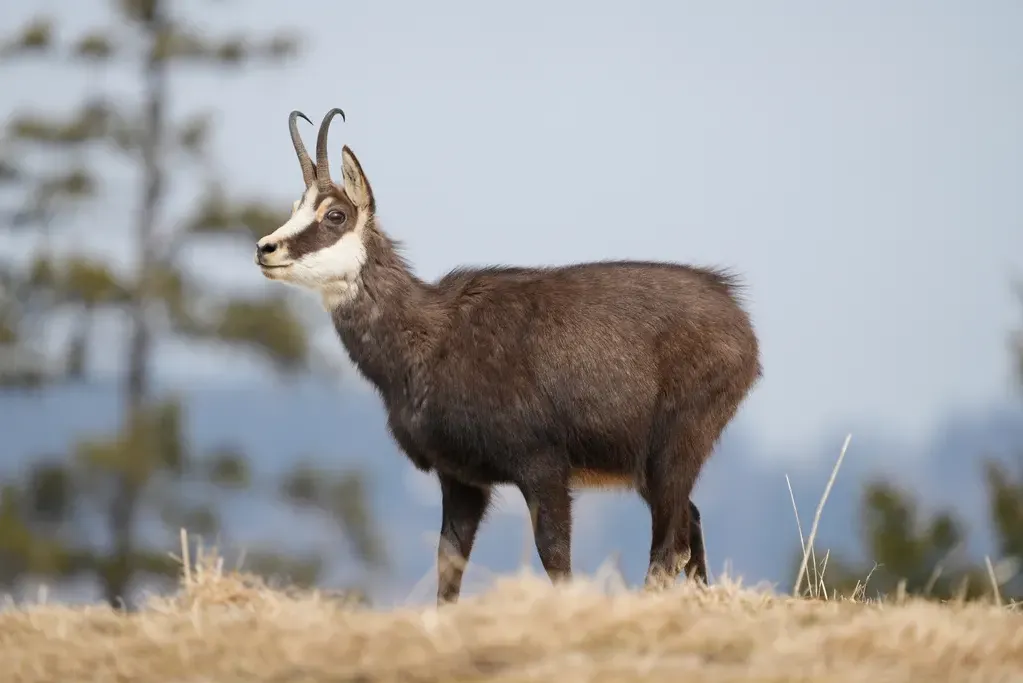
A very small bovid: 70–80 cm at the shoulder and 107–137 cm long, bucks weighing 30–60 kg and does 25–45 kg. Both sexes carry short, straightish horns that hook sharply backwards near the tip, the buck's thicker than the doe's. The summer coat is a rich brown that turns light grey in winter. The face is the giveaway: white contrasting marks on the sides of the head with pronounced black stripes below the eyes, together with a white rump and a black stripe along the back.
Chapter 03
Behaviour
Does and their young live in herds of 15 to 30; adult bucks are solitary for most of the year. The rut falls in late November and early December in Europe, when bucks fight fiercely over unmated does. After a gestation of 170 days a single kid, rarely twins, is born in May or early June. Young males are driven out of the herd at maturity and wander until they can establish themselves as breeders at eight or nine years old. Chamois graze highland grasses and herbs in summer and turn to conifers, bark and needles in winter. They are mainly active by day, rest around midday and may forage on moonlit nights. A resting group keeps a lookout, and the alarm is a shrill whistle and a stamp of the foot before the whole group takes off. They escape by speed and stealth, running at 50 km/h and jumping 2 m straight up or 6 m across. Avalanches, epidemics and predation kill them; humans are now their main predator.
Chapter 04
Hunting
Chamois are popular game, sought for their meat, and two habits are used against them. They feed mostly in the morning and evening, and they watch for danger from below — so a hunter who stalks them from above is less likely to be seen and more likely to succeed. The tuft of hair from the back of the neck, the gamsbart, is traditionally worn on hats across the alpine countries. In New Zealand, where chamois from the Austrian Emperor Franz Joseph I were released around Mount Cook in 1907 and spread over much of the South Island, hunting is unrestricted and even encouraged by the Department of Conservation to protect the native alpine flora. New Zealand chamois weigh about 20 per cent less than European ones of the same age.
Field data
Tracks
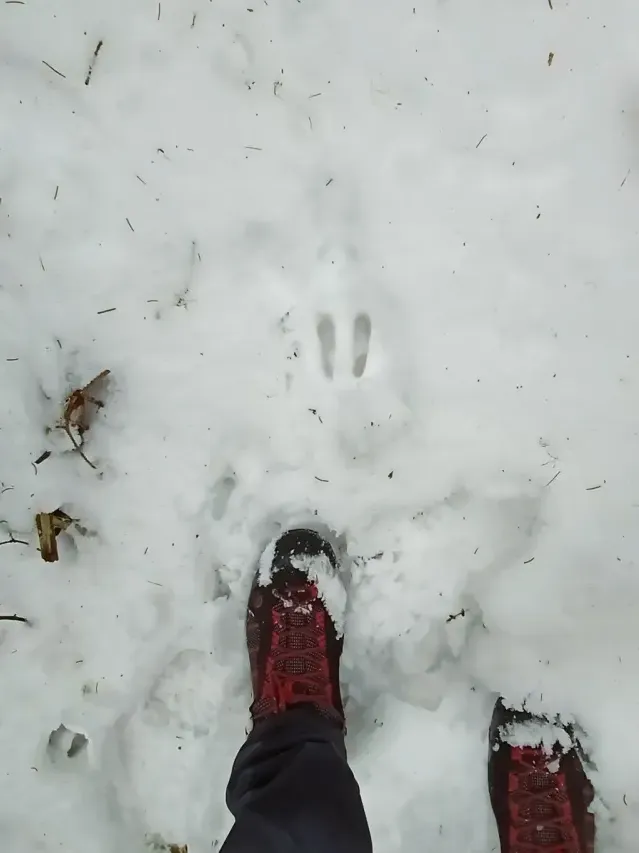
A photograph of real sign left by Alpine chamois. Prints vary with gait, ground and how long they have been there — treat this as one example, not a template.
Track photo:Malte KrömerCC BY
On the table
Meat & cooking
Table grade 1 of 51/5
- Sold as meat in a legal market
- Has a named traditional dish
- Published way to handle and cook it
- Eaten in more than one country
- No known health advisory
Sources
Sources: Chamois — Wikipedia, Gems — Wikipedia (sv) — read 2026-10-29
Cross-reference
Related species
Its closest relatives in the compendium, nearest kinship first.
Big game
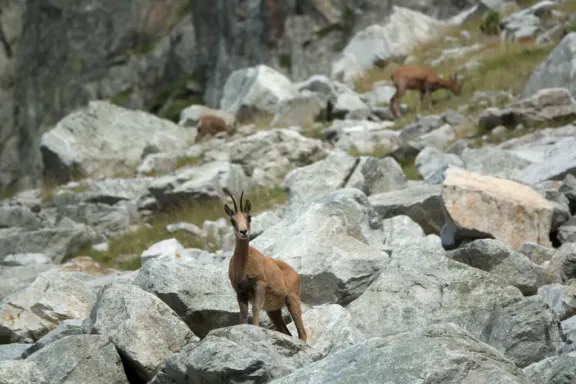
Pyrenean chamois
Rupicapra pyrenaica
Same genus (Rupicapra)
Big game
European mouflon
Ovis gmelini musimon
Same subfamily (Caprinae)
Big game
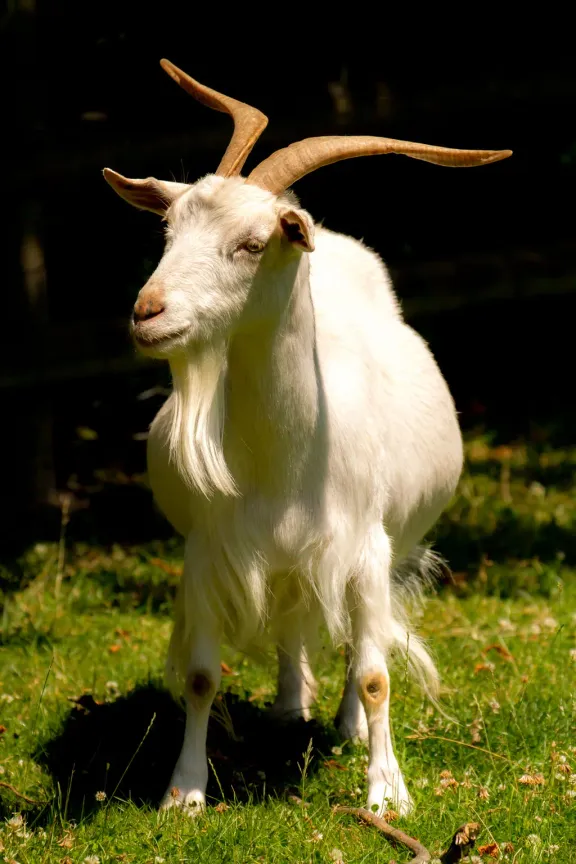
Feral goat
Capra hircus
Same subfamily (Caprinae)
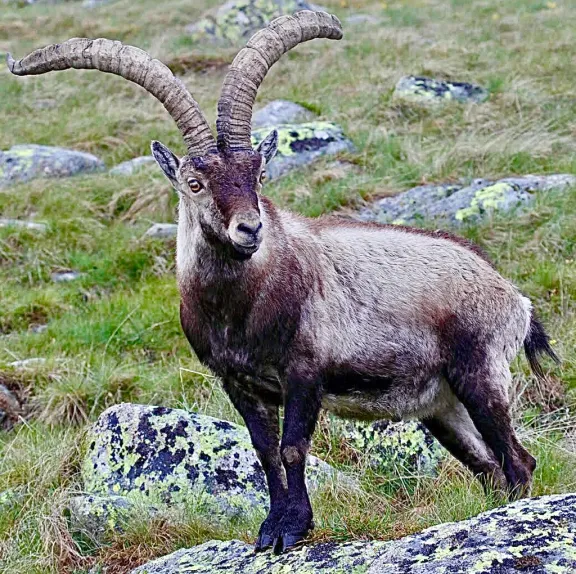
Big game
Iberian ibex
Capra pyrenaica
Same subfamily (Caprinae)
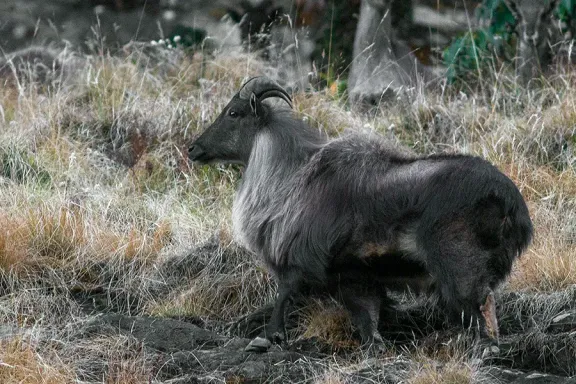
Big game
Himalayan tahr
Hemitragus jemlahicus
Same subfamily (Caprinae)
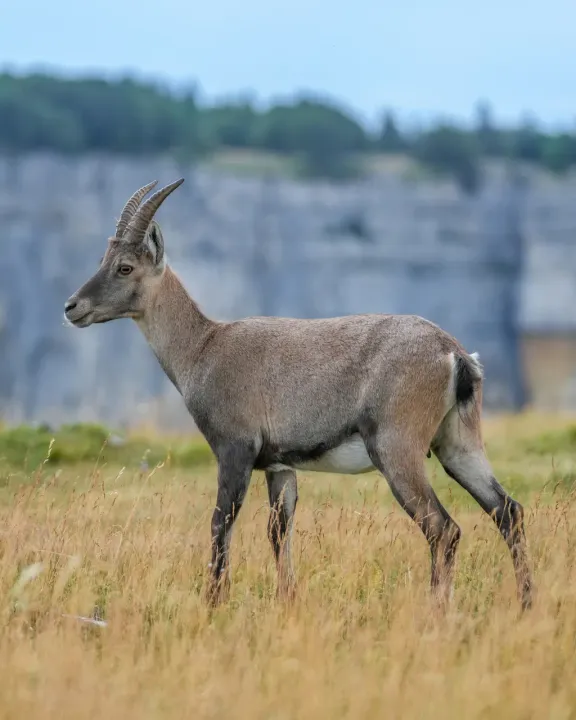
Big game
Alpine ibex
Capra ibex
Same subfamily (Caprinae)