Big game
Alpine ibex
Capra ibex
- Group
- Big game
- Size class
- Large (70–300 kg)
- Family
- Bovidae
Range
- Europe
Habitat
- Mountain
Range
Countries it is found in
7 countries
- Austria
- France
- Germany
- Italy
- Liechtenstein
- Slovenia
- Switzerland
Range from:ASM Mammal Diversity Database, GBIF occurrence records — read 2026-08-05
Chapter 01
Overview
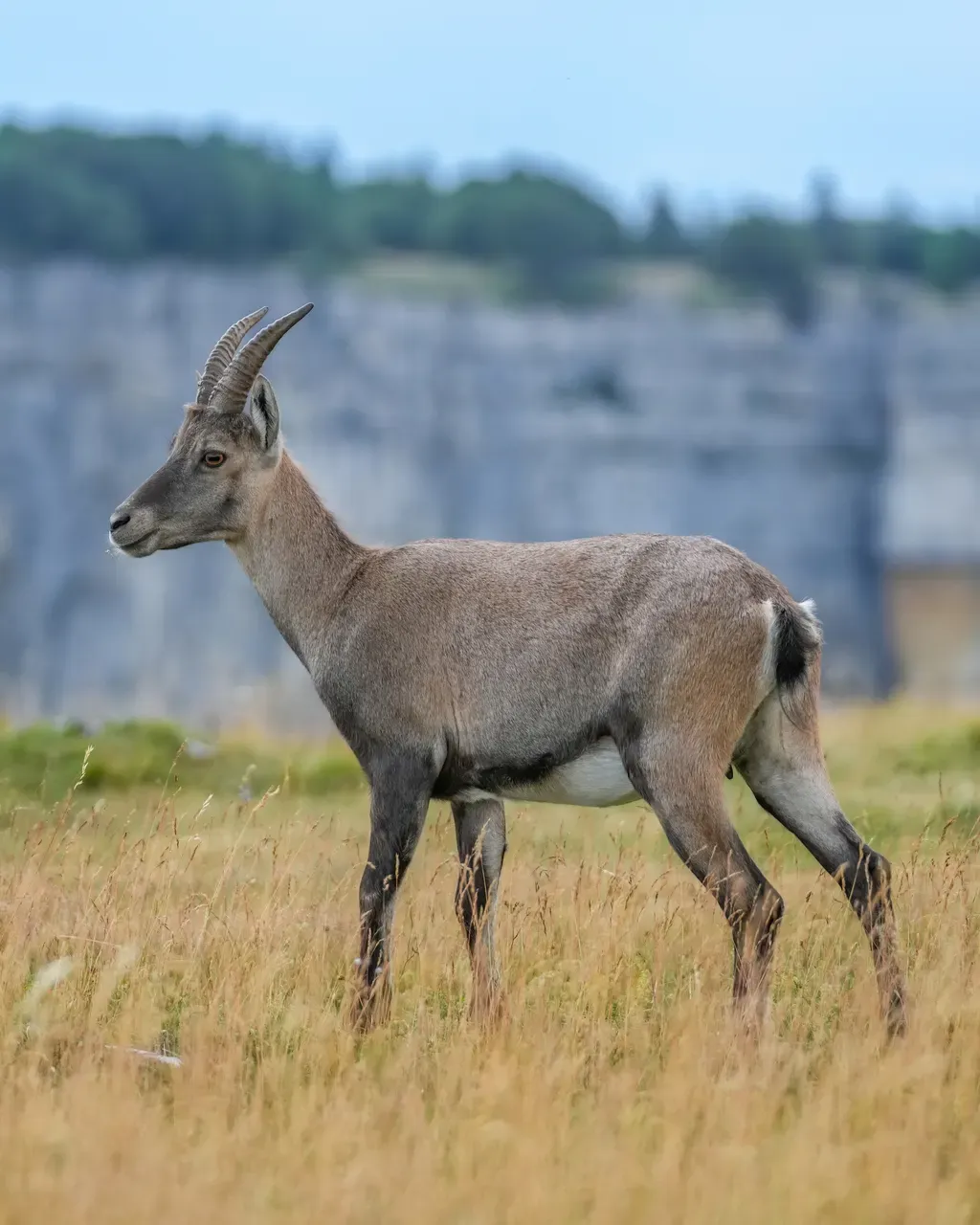
The Alpine ibex (Capra ibex), or steinbock — from Old High German steinboc, "stone buck" — is a wild goat of the Alps, found in France, Switzerland, Liechtenstein, Italy, Germany and Austria and reintroduced or introduced to Slovenia and Bulgaria. Its closest living relative is the Iberian ibex. It lives in steep, rough terrain and open alpine meadows at 1,800 to 3,300 m, favouring slopes of 30–45° and sheltering in small caves and overhangs. Its history is one of near loss. By the 19th century hunting had reduced it to fewer than 100 animals in and around Gran Paradiso in Italy, and every ibex alive today descends from them. Reintroduction from that stock, starting with captive breeding in Switzerland from 1902, brought the population to 55,297 in 2015. The IUCN lists it as least concern with a stable trend, though its genetic diversity remains very low.
Chapter 02
Identification
Strongly dimorphic. Billies stand 90–101 cm at the withers, measure 149–171 cm and weigh 67–117 kg; nannies stand 73–84 cm, measure 121–141 cm and weigh only 17–32 kg. It is a stocky goat with a tough neck, robust legs and a wide, short snout, with sharp, widely separated hooves and a rubbery callus under the front feet for climbing. Both sexes carry large, backward-curving horns, marked on the front by transverse ridges; the billy's reach 69–98 cm, the nanny's only 18–35 cm. The coat is brownish-grey, paler on the belly, with dark markings on chin and throat and a nearly black chest, duller than other wild goats. Only males have a beard. A thick woolly winter coat is moulted in spring for a short, thin summer one. Age can be read from the annual growth rings on the horns.
Chapter 03
Behaviour
Strictly herbivorous and mostly a grass-eater, adding herbs in summer and dwarf shrubs and conifer shoots in autumn and winter. It does not hibernate, but lowers its heart rate and metabolism, shelters on cold nights and basks in the morning. Large males suffer heat stress and may feed at night instead. Its climbing is extraordinary: nannies and kids have been watched scaling the 57-degree face of the Cingino Dam in Piedmont to lick salt. The sexes live apart for most of the year, nanny groups of 5–10 and billy groups of 2–16 or occasionally more than 50, and come together for the rut in December and January. Billies settle a dominance hierarchy by size, age and horn length outside the breeding season and fight by rearing and clashing downwards. Dominant billies of nine to twelve tend an oestrous nanny while younger ones try to sneak past. After about five months' gestation one kid, sometimes two, is born on rocky slopes. The alarm is a short, sharp whistle.
Chapter 04
Hunting
Hunting is what nearly ended the species. From the early 16th century, and especially once firearms came in, the population across the Alps fell almost entirely to human hunting; folk medicine added to the pressure, since horn and blood were prized as cures. In 1821 the Government of Piedmont banned hunting of the Alpine ibex, and in 1854 Victor Emmanuel II made Gran Paradiso a royal hunting reserve, which became a national park in 1920. According to the IUCN the recovered species now has a low conservation dependence, and some countries allow limited hunting. Disease is also managed by culling: in the Bornes Massif of the French Alps a test-and-cull programme cut Brucella infection in adult females from 51 per cent in 2013 to 21 per cent in 2018.
Field data
Tracks
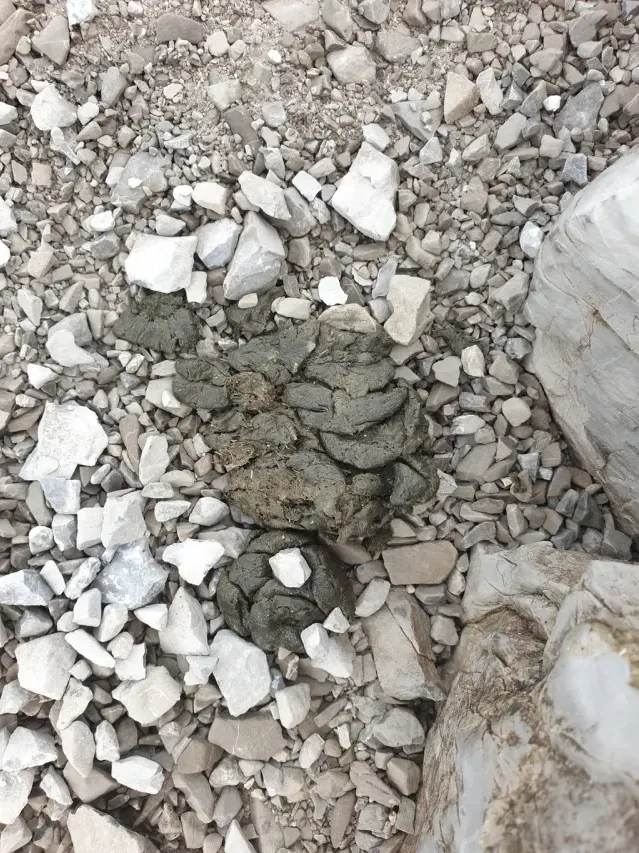
A photograph of real sign left by Alpine ibex. Prints vary with gait, ground and how long they have been there — treat this as one example, not a template.
Track photo:Emil JantkeCC BY
Sources
Sources: Alpine ibex — Wikipedia, Stenbock — Wikipedia (sv) — read 2026-10-29
Cross-reference
Related species
Its closest relatives in the compendium, nearest kinship first.
Big game
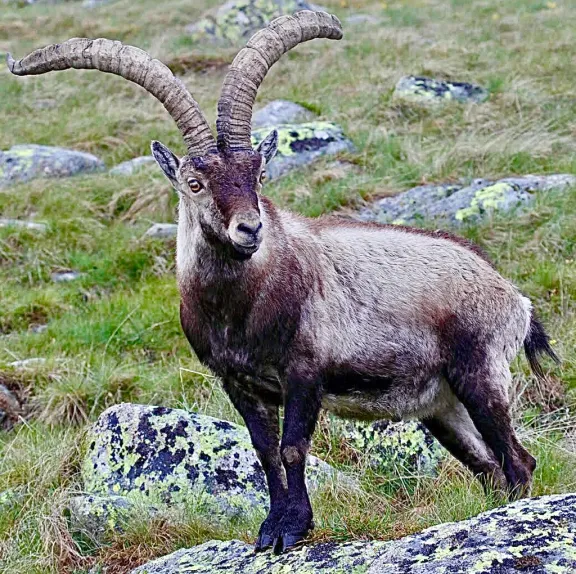
Iberian ibex
Capra pyrenaica
Same genus (Capra)
Big game
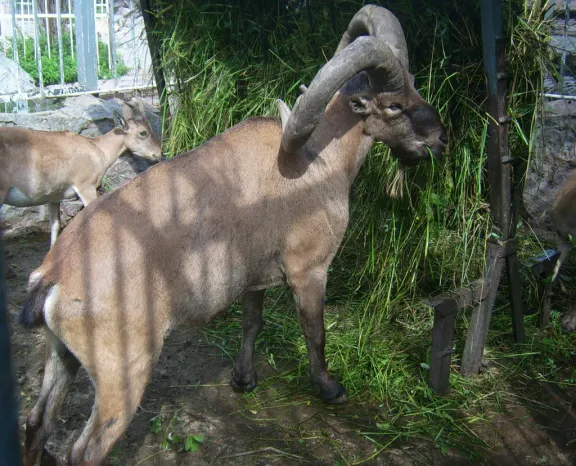
East Caucasian tur
Capra cylindricornis
Same genus (Capra)
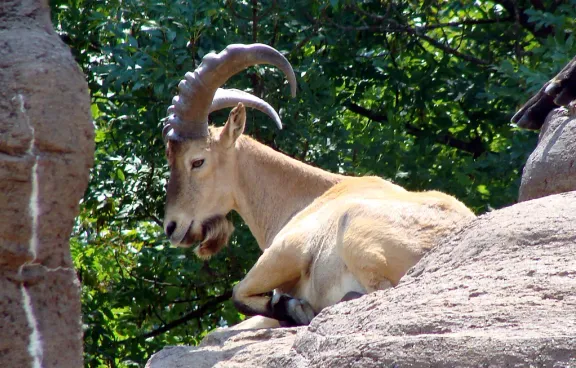
Big game
West Caucasian tur
Capra caucasica
Same genus (Capra)
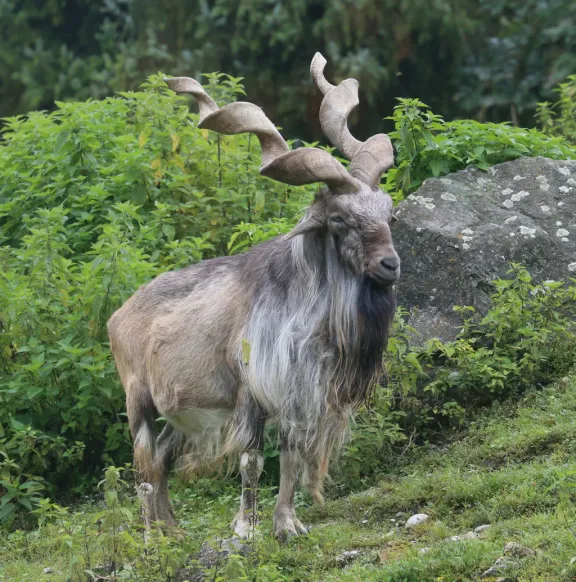
Big game
Markhor
Capra falconeri
Same genus (Capra)
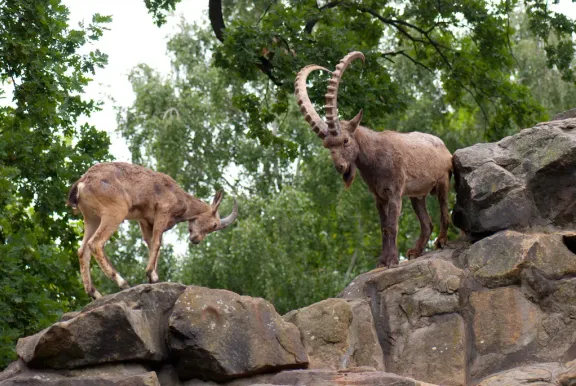
Big game
Siberian ibex
Capra sibirica
Same genus (Capra)
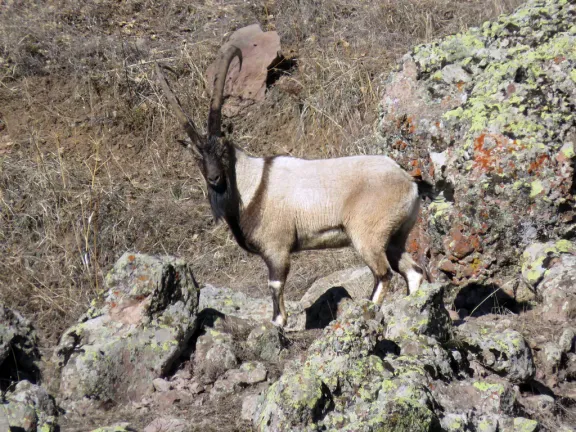
Big game
Bezoar ibex
Capra aegagrus
Same genus (Capra)