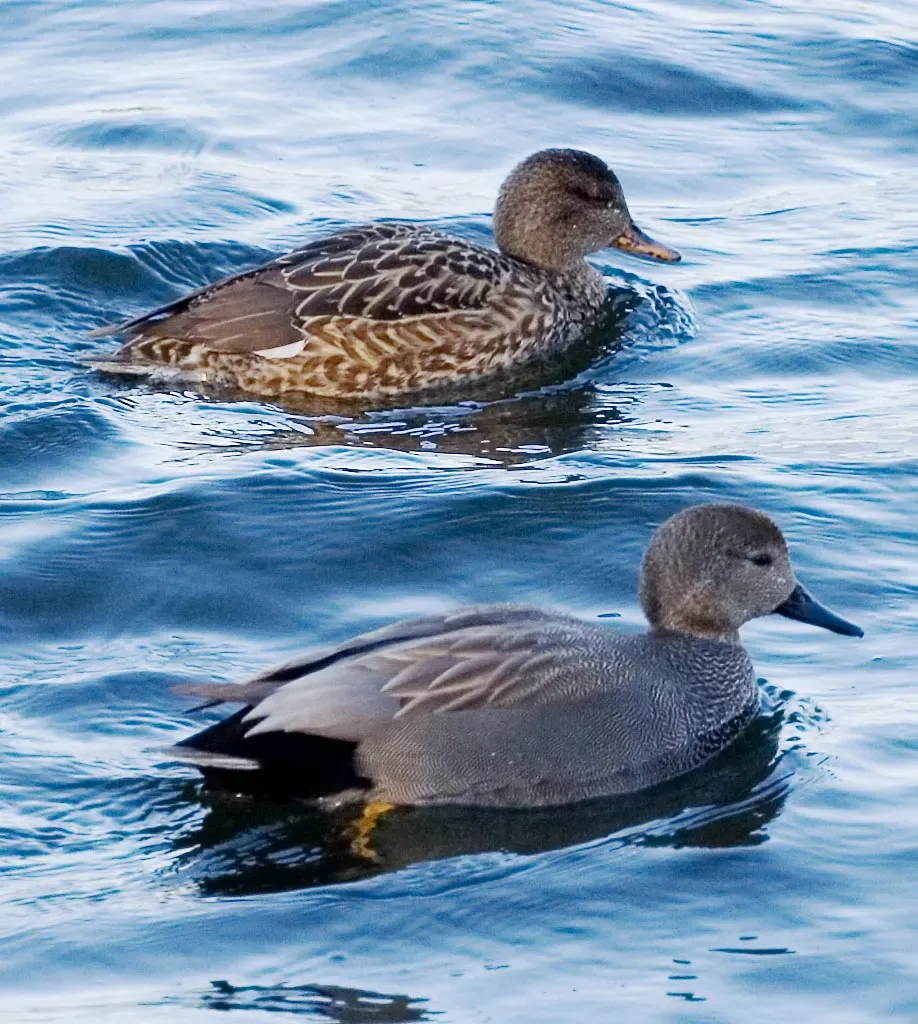
Photo:UnknownCC BY-SA 2.0
Waterfowl
Gadwall
Mareca strepera
- Group
- Waterfowl
- Size class
- Small (under 10 kg)
- Family
- Anatidae
Range
- North America
- Europe
- Asia
Habitat
- Wetland
Range
Countries it is found in
99 countries
- Afghanistan
- Albania
- Algeria
- Armenia
- Austria
- Azerbaijan
- Bahrain
- Bangladesh
- Belarus
- Belgium
- Bermuda
- Bhutan
- Bosnia & Herzegovina
- Bulgaria
- Canada
- China
- Colombia
- Croatia
- Cuba
- Cyprus
- Czechia
- Denmark
- Egypt
- Eritrea
Range from:Wikipedia country bird lists — read 2026-08-05
Chapter 01
Overview
The gadwall (Mareca strepera) is a common and widespread dabbling duck. DNA studies show it to be the sister species of the falcated duck, and the two are close to the wigeons, with which they share the genus Mareca; strepera is Late Latin for 'noisy'. A second subspecies, Coues's gadwall, lived only on the Pacific atoll of Teraina and died out around 1874. It breeds in northern Europe and across the Palearctic and in central North America, and is strongly migratory, wintering south of its breeding range as far as Central America. In Britain it is a scarce breeder and winter visitor that has increased in recent years, partly through introduction and partly through continental birds staying to breed. The IUCN lists it as least concern; its numbers grew between 1966 and 2010 and continue to rise, and in North America its range appears to be expanding eastwards.
Chapter 02
Identification
The gadwall is 47–58 cm long with a 78–85 cm wingspan; the drake averages 990 g against the duck's 850 g. The breeding drake is finely patterned grey with a black rear end, light chestnut on the wings and a brilliant white speculum that shows in flight and at rest. In eclipse he looks more like the female but keeps the male wing pattern, and is usually greyer above with less orange on the bill. The female is light brown, much like a female mallard, but smaller, with a dark bill edged in orange, the white speculum and a white belly. It is a quiet duck outside courtship: the female's quack is like a mallard's but higher, a gag-ag-ag-ag, while the drake gives a grunting mep and a whistle.
Chapter 03
Behaviour
A bird of open wetlands — prairie and steppe lakes, wet grassland and marshes with dense fringing vegetation. It usually feeds by dabbling for plant food with the head submerged, but dives more readily than other dabbling ducks and may steal food from diving birds such as coots. Outside the breeding season it is less gregarious than some dabblers and tends to keep to small flocks. Gadwalls are monogamous and may breed after their first year, pairing during the autumn migration or on the breeding grounds. In the burp display the drake raises his head towards a female with a mep call; in the grunt-whistle he flicks a stream of droplets towards her. The nest is on the ground, often some way from water, and the female lays 7–12 eggs, incubated for 24–27 days; the ducklings leave the nest after a day or two, and only one brood is raised a season.
Chapter 04
Hunting
The gadwall is one of the most hunted ducks in North America, third after the mallard and green-winged teal, with 1.7 million shot each year; through the work of Ducks Unlimited, the Delta Waterfowl Foundation and other conservation groups the species continues to be hunted sustainably there. It is covered by the African-Eurasian Waterbird Agreement (AEWA). In Sweden the gadwall has no open season under the Hunting Ordinance as it stands. An amendment (SFS 2026:1693) taking effect on 1 July 2027 gives it a season of 21 August–31 December in the counties of Värmland, Örebro, Västmanland, Uppsala, Stockholm, Södermanland, Västra Götaland, Östergötland, Halland, Jönköping, Kalmar, Gotland, Kronoberg and Skåne.
Sources
Sources: Gadwall — Wikipedia, Jaktförordning (1987:905) — Sveriges riksdag — read 2026-10-29
Cross-reference
Related species
Its closest relatives in the compendium, nearest kinship first.
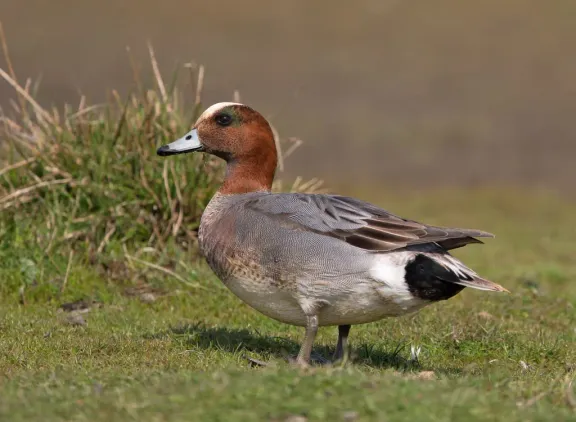
Waterfowl
Eurasian wigeon
Mareca penelope
Same genus (Mareca)
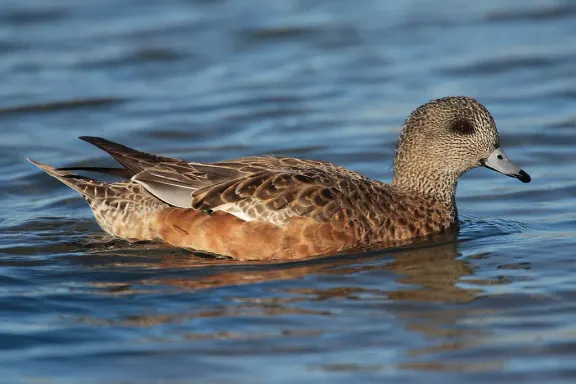
Waterfowl
American wigeon
Mareca americana
Same genus (Mareca)
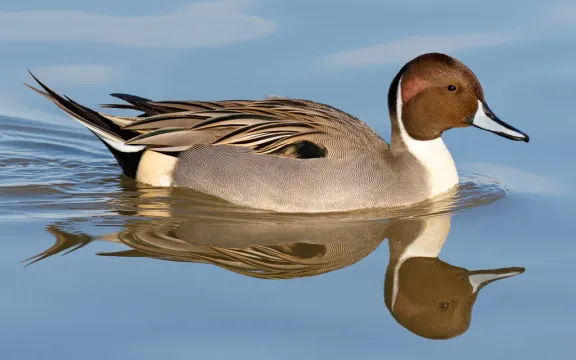
Waterfowl
Northern pintail
Anas acuta
Same subfamily (Anatinae)
Waterfowl
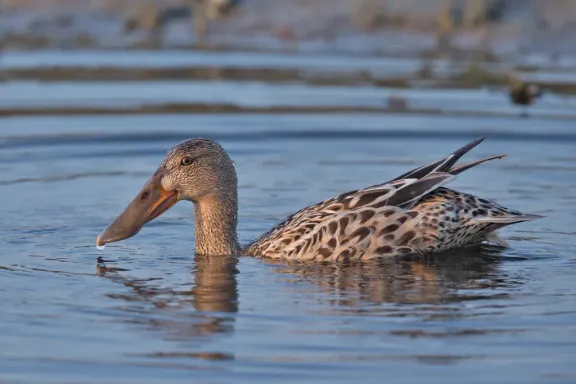
Northern shoveler
Spatula clypeata
Same subfamily (Anatinae)
Waterfowl
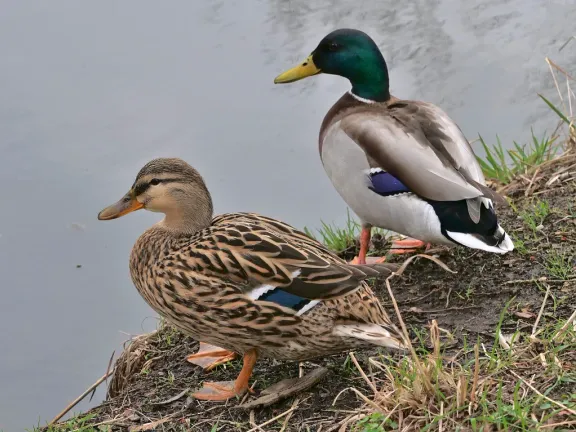
Mallard
Anas platyrhynchos
Same subfamily (Anatinae)
Waterfowl
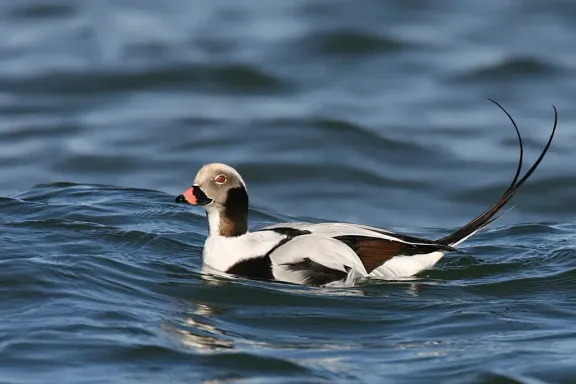
Long-tailed duck
Clangula hyemalis
Same subfamily (Anatinae)