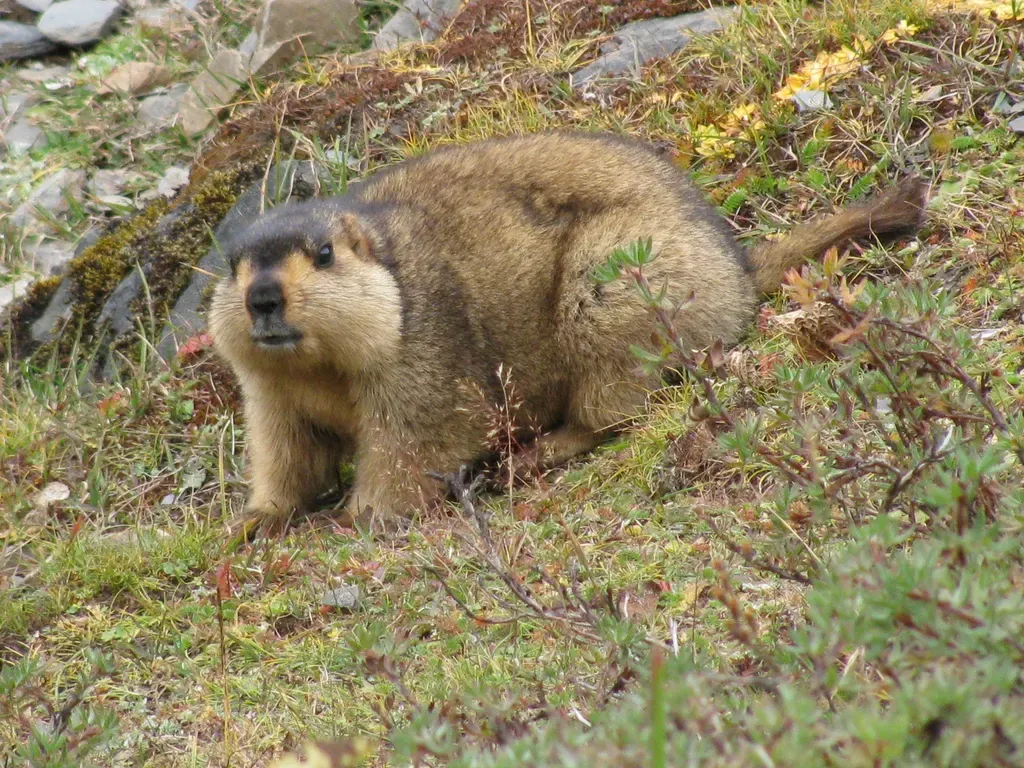
Small game
Himalayan marmot
Marmota himalayana
- Group
- Small game
- Size class
- Small (under 10 kg)
- Family
- Sciuridae
Range
- Asia
Habitat
- Mountain
Range
Countries it is found in
4 countries
- China
- India
- Nepal
- Pakistan
Range from:ASM Mammal Diversity Database — read 2026-08-05
Chapter 01
Overview
The Himalayan marmot (Marmota himalayana) lives in the alpine grasslands of the Himalayas and the Tibetan Plateau at 3,000–5,500 m, in north-eastern Pakistan, northern India, Nepal, Bhutan and China. In India it can be seen in the high country of Ladakh and Kashmir, and in China it has been recorded in Xinjiang, Qinghai, Gansu, Tibet, western Sichuan and Yunnan. Hodgson described it in 1841 from skins collected in the Himalayas; two subspecies are recognised, the nominate and the Szechwan marmot, M. h. robusta. Its closest relative is the tarbagan marmot, and in the west its range meets that of the long-tailed marmot, though the two are not known to hybridise. It lives in short-grass steppe and alpine country, typically above the tree line but below the permanent snow. The IUCN lists it as least concern because of its wide range and probably large population.
Chapter 02
Identification
One of the largest marmots, about the size of a big housecat: total length 45–67 cm, of which the short tail is only 12–15 cm, and weight 4–9.2 kg — lowest in spring after hibernation and highest before it, averaging over 7 kg in autumn in both sexes. No size difference between the sexes has been found. The dense, woolly fur is rufous grey on the back and rufous yellowish on the ears, belly and limbs, while the bridge of the nose and the tail tip are dark brown. The skull is relatively large, the ears small and the hind feet very large, up to 10 cm long.
Chapter 03
Behaviour
Himalayan marmots live in colonies and are active by day, most of all in the early morning and late afternoon. They dig unusually deep burrows — 2 to 3.5 m for ordinary use and up to 10 m for hibernation — where the soil is light and deep enough, and on ideal alluvial terraces a colony can hold up to 30 families, with as many as ten in a square kilometre. The colony hibernates together from late autumn to early spring, on average for seven and a half months. They eat the soft, juicy parts of pasture grasses and sedges and flowering plants such as gentians, primulas, buttercups and dandelions, and avoid old growth that tastes bitter. Females mature at two years and, after about a month's gestation, give birth to two to eleven young. Predators include snow leopards, Tibetan wolves, red foxes and golden eagles; in Ladakh, marmots fed by people have grown less wary and fall more easily to stray dogs.
Sources
Sources: Himalayan marmot — Wikipedia, Himalayamurmeldjur — Wikipedia (sv) — read 2026-10-29
Cross-reference
Related species
Its closest relatives in the compendium, nearest kinship first.
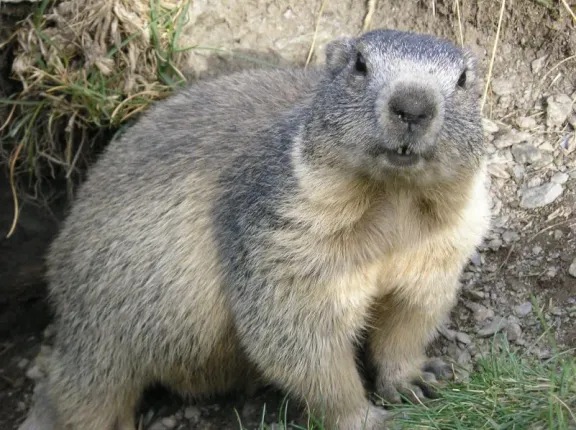
Small game
Alpine marmot
Marmota marmota
Same genus (Marmota)
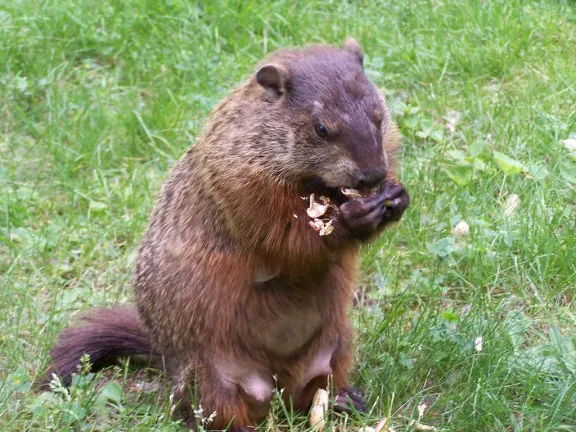
Small game
Groundhog
Marmota monax
Same genus (Marmota)
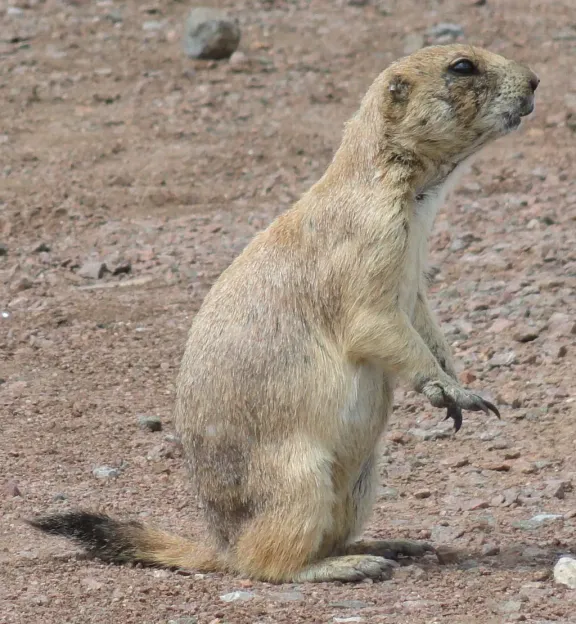
Small game
Black-tailed prairie dog
Cynomys ludovicianus
Same tribe (Marmotini)
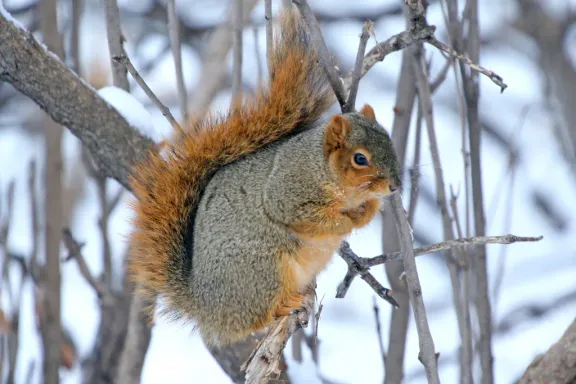
Small game
Fox squirrel
Sciurus niger
Same family (Sciuridae)
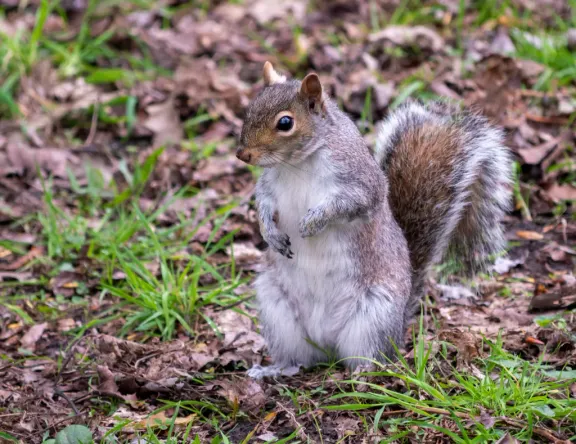
Small game
Eastern gray squirrel
Sciurus carolinensis
Same family (Sciuridae)
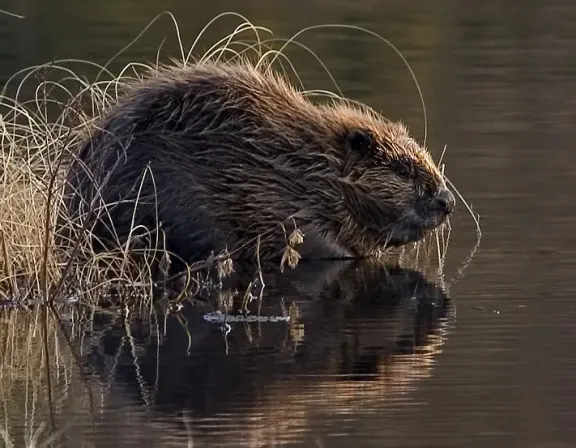
Small game
European beaver
Castor fiber
Same order (Rodentia)