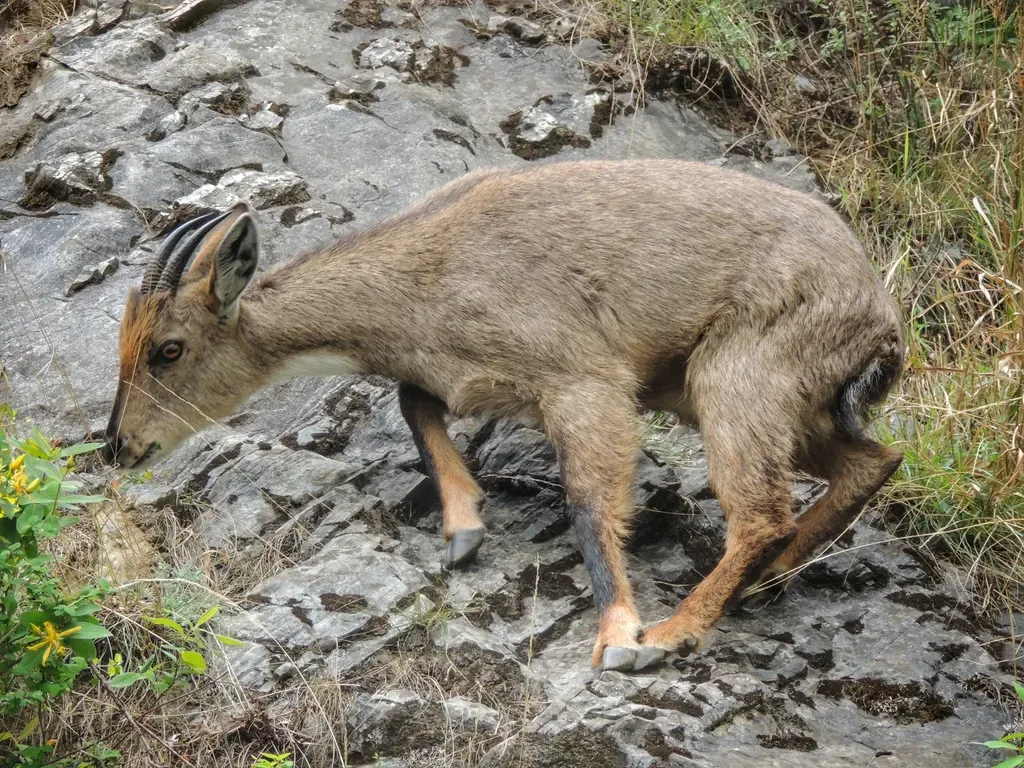
Photo:SubhegCC BY-SA 4.0
Big game
Himalayan goral
Naemorhedus goral
- Group
- Big game
- Size class
- Medium (10–70 kg)
- Family
- Bovidae
Range
- Asia
Habitat
- Mountain
Range
Countries it is found in
5 countries
- Bhutan
- China
- India
- Nepal
- Pakistan
Range from:ASM Mammal Diversity Database — read 2026-08-05
Chapter 01
Overview
The Himalayan goral (Naemorhedus goral), or grey goral, is a small goat-antelope of the Himalayas, found from Chitral and Gilgit-Baltistan in Pakistan through Nepal, Bhutan and southern Tibet to Sikkim and Arunachal Pradesh in India, and possibly western Myanmar. It lives mainly in mountain forest and on cliffs, most commonly at 900–2,750 m, though in Pakistan it has been recorded from 1,000 to 4,000 m. The IUCN lists it as near threatened, as its numbers are thought to be falling significantly through habitat loss and hunting for meat. Pakistan held only about 370–1,017 animals in 2004, in seven isolated populations.
Chapter 02
Identification
A small, stocky goat-antelope 95–130 cm long, with a tail of up to 18 cm, a shoulder height of about 80 cm and a weight of 35–42 kg. The coat is grey or grey-brown, with tan to almost whitish legs, lighter patches on the throat and a single dark stripe along the spine; the winter coat is much thicker than the summer one. Males have a short mane on the neck. Both sexes carry short, backward-curving horns of 13–18 cm. Gorals differ from the closely related serows by lacking the preorbital glands below the eyes and the matching hollows in the skull.
Chapter 03
Behaviour
The goral is crepuscular, most active in the morning and late afternoon and in cool weather also at midday, resting through the day on a rock ledge. It is an exceptional climber, agile and fast, and its colouring camouflages it so well that it is very hard to spot as it lies still. It feeds on leaves, twigs, nuts and especially grasses. Groups of four to twelve hold home ranges of about 40 ha, while older males pair off or live alone and mark territories of 22–25 ha in the breeding season. After a gestation of 170–218 days the female usually bears one young, occasionally up to three, which is weaned at seven to eight months and matures at about three years; gorals live up to 15 years. The Himalayan wolf is a notable predator, along with leopard, lynx, tiger, dhole and martens.
Chapter 04
Hunting
Hunting, together with habitat loss, is the main threat to the goral, and the IUCN's near-threatened listing rests on hunting for meat among other pressures. It is listed on CITES Appendix I.
On the table
Meat & cooking
Table grade 1 of 51/5
- Sold as meat in a legal market
- Has a named traditional dish
- Published way to handle and cook it
- Eaten in more than one country
- No known health advisory
Sources
Sources: Himalayan goral — Wikipedia, Goral (getdjur) — Wikipedia (sv) — read 2026-10-29
Cross-reference
Related species
Its closest relatives in the compendium, nearest kinship first.
Big game
European mouflon
Ovis gmelini musimon
Same subfamily (Caprinae)
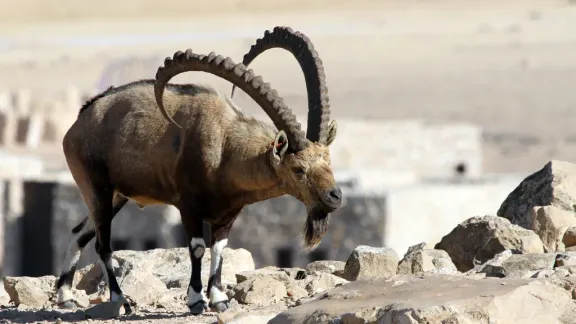
Big game
Nubian ibex
Capra nubiana
Same subfamily (Caprinae)
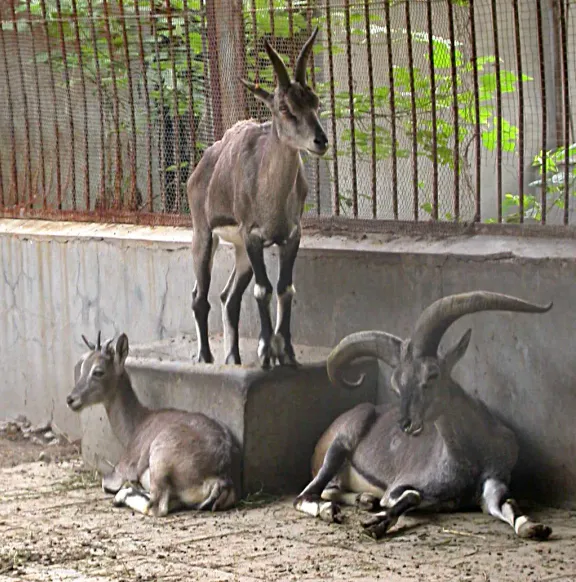
Big game
Blue sheep (bharal)
Pseudois nayaur
Same subfamily (Caprinae)
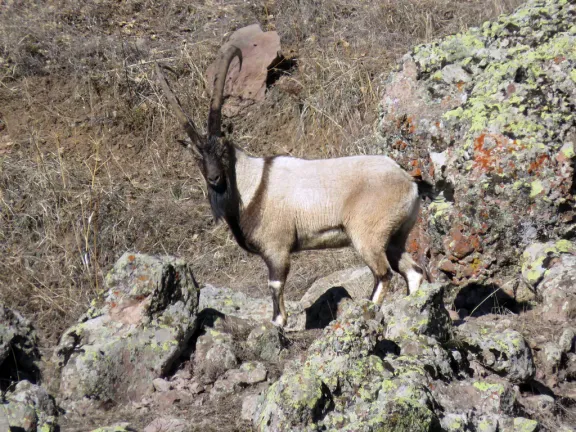
Big game
Bezoar ibex
Capra aegagrus
Same subfamily (Caprinae)
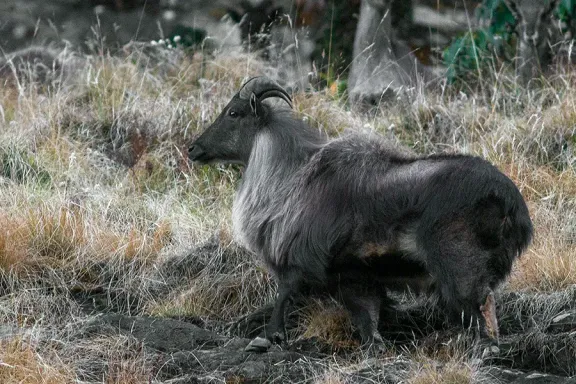
Big game
Himalayan tahr
Hemitragus jemlahicus
Same subfamily (Caprinae)
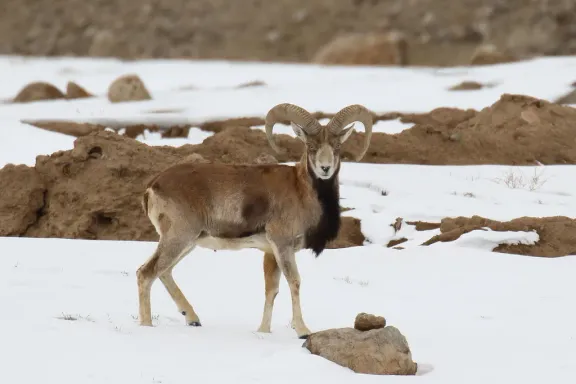
Big game
Urial
Ovis vignei
Same subfamily (Caprinae)