Photo:ALAN SCHMIERERCC0
Waterfowl
King eider
Somateria spectabilis
- Group
- Waterfowl
- Size class
- Small (under 10 kg)
- Family
- Anatidae
Range
- Arctic
- North America
Habitat
- Coast
Range
Countries it is found in
11 countries
- Canada
- Faroe Islands
- Finland
- Greenland
- Iceland
- Norway
- Russia
- St. Pierre & Miquelon
- Svalbard & Jan Mayen
- Sweden
- United States
Range from:Wikipedia country bird lists, GBIF occurrence records — read 2026-08-05
Chapter 01
Overview
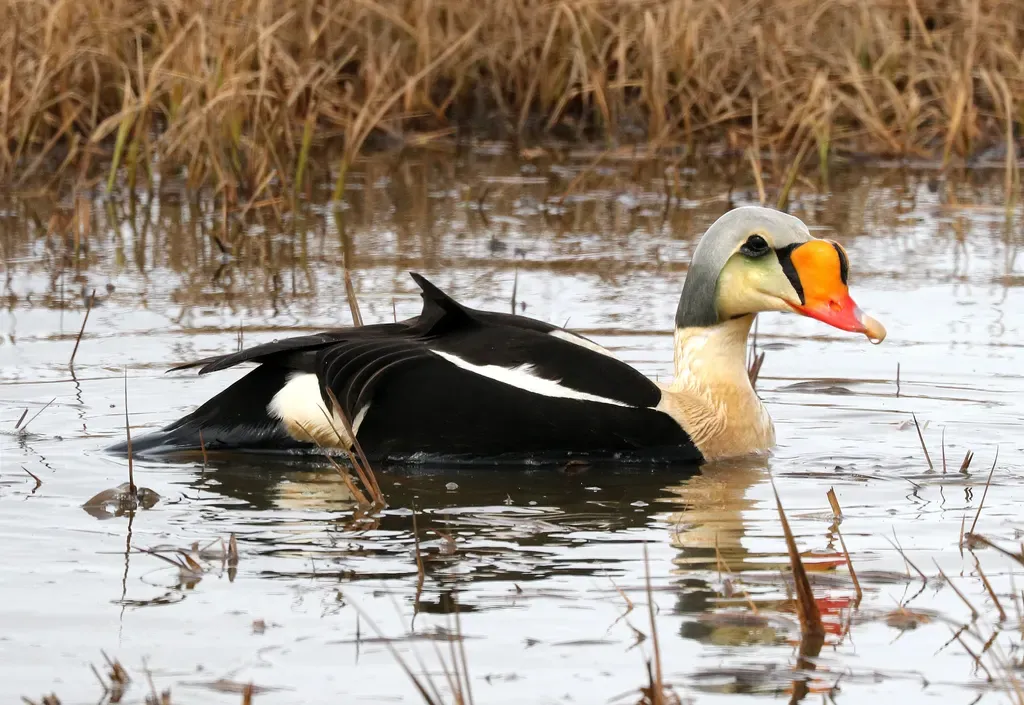
The king eider (Somateria spectabilis) is a large sea duck of the Arctic coasts of north-east Europe, North America and Asia. It spends most of the year at sea in high latitudes and comes ashore to the tundra only to breed in June and July, on the coasts of Alaska, Canada, Greenland, Svalbard and Russia. It winters in Arctic and subarctic waters — the Bering Sea, west Greenland, eastern Canada and northern Norway above all — in flocks that can exceed 100,000 birds, and turns up every year off the north-eastern United States, Scotland and Kamchatka. Linnaeus put it in Anas in 1758; Leach moved it to Somateria, 'woolly body', for the eiders' down, in 1819. Spectabilis means 'showy', and 'king' — a translation of its Icelandic name — refers to the orange, crown-like knob above the male's bill. The world population is put at 800,000–900,000 and the IUCN lists it as least concern, though its trend is downward. In Sweden it is rare but seen regularly from March to May, mostly among common eiders on the southern coasts; a pure flock of 21 was seen on Gotland in 1986.
Chapter 02
Identification
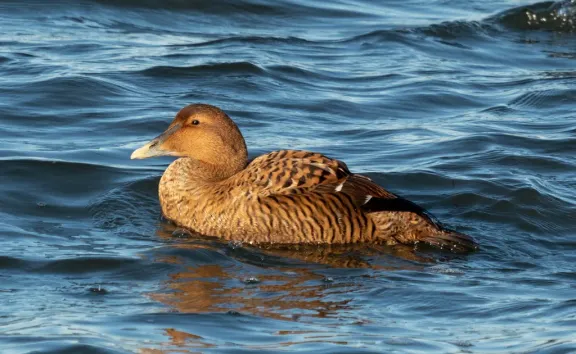
A large sea duck, 50–70 cm long with a wingspan of 86–102 cm, a little smaller and more compact than the common eider and with a smaller bill. Males average 1.67 kg and females 1.57 kg, though a bird may weigh anything from 0.9 to 2.2 kg through the year. The breeding male is unmistakable: mostly black body, buff-tinged white breast, pale blue-grey crown and nape, pale green cheek, and a red bill with a large yellow-orange knob; curved tertials stand up as two small 'sails' on the back. The female is warm brown, her blackish markings more chevron-shaped than the common eider's, with a buff spot at the bill base and a buff eye ring curving down behind the eye; her upturned gape gives her a gentle expression. Young males take three years to reach full adult plumage. The male's call is a quavering, dove-like croo-croo-croo; the female clucks, grunts and growls.
Chapter 03
Behaviour
For most of the year the king eider is at sea, diving for bottom-living invertebrates — molluscs, crustaceans such as king crabs, sea urchins, starfish and sea anemones — and paddling with its wings on deeper dives. On the breeding grounds it feeds on freshwater lakes and ponds instead, dabbling small invertebrates from the surface. The nest is a scrape on dry tundra, usually near water and generally within 50 km of the coast, lined with vegetation and the female's own down; she lays 2–7 eggs and incubates alone for 22–23 days, and the females then raise the young together. The males gather soon after laying and fly to sheltered coasts to moult in July and August. Glaucous gulls, ravens, jaegers and Arctic foxes take eggs and young. The oldest known bird, a female ringed near Gambell in Alaska in 1940, was shot at Utqiagvik in 1958, nearly 19 years later.
Chapter 04
Hunting
The king eider is a regular source of fresh meat in spring for many Arctic peoples. In Yup'ik it is qengallek; the birds pass the Yukon–Kuskokwim Delta from late April and are hunted there in great numbers, and in May several hundred thousand pass Point Barrow on the way to their breeding grounds. In Alaska's 2026 spring and summer subsistence harvest the king eider is open, apart from a closure on king and common eiders in the North Slope Region from 7 June to 6 July, and lead shot is banned. In Greenland the wintering population is threatened by overexploitation, with 10–20 percent killed each year. In the US Atlantic Flyway eiders are taken within the duck bag: no more than 4 sea ducks a day, of which no more than 3 eiders and no more than 1 female eider. In Sweden the praktejder has no open season — the Hunting Ordinance gives a jakttid for the common eider, ejder, but none for this species, so it is protected.
On the table
Meat & cooking
Table grade 2 of 52/5
- Sold as meat in a legal market
- Has a named traditional dish
- Published way to handle and cook it
- Eaten in more than one country
- No known health advisory
Sources
Sources: King eider — Wikipedia, Praktejder — Wikipedia (sv), U.S. Fish & Wildlife Service: Regulations for the 2026 Alaska Subsistence Spring/Summer Migratory Bird Harvest, U.S. Fish & Wildlife Service: General Decision Frameworks for Annual Migratory Game Bird Hunting Seasons — Atlantic Flyway (27 August 2026), Jaktförordning (1987:905) — Sveriges riksdag — read 2026-10-29
Cross-reference
Related species
Its closest relatives in the compendium, nearest kinship first.
Waterfowl
Common eider
Somateria mollissima
Same genus (Somateria)
Waterfowl
Long-tailed duck
Clangula hyemalis
Same subfamily (Anatinae)

Waterfowl
Harlequin duck
Histrionicus histrionicus
Same subfamily (Anatinae)
Waterfowl
Common merganser (goosander)
Mergus merganser
Same subfamily (Anatinae)
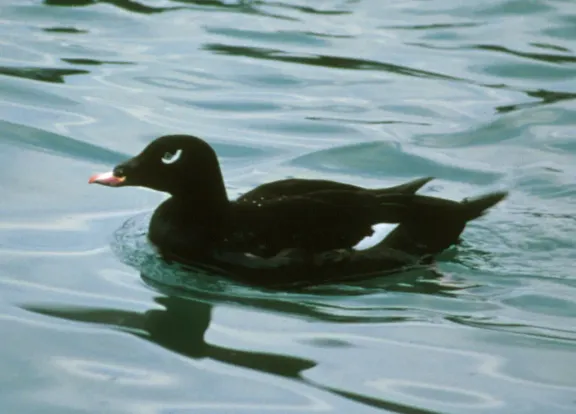
Waterfowl
White-winged scoter
Melanitta deglandi
Same subfamily (Anatinae)
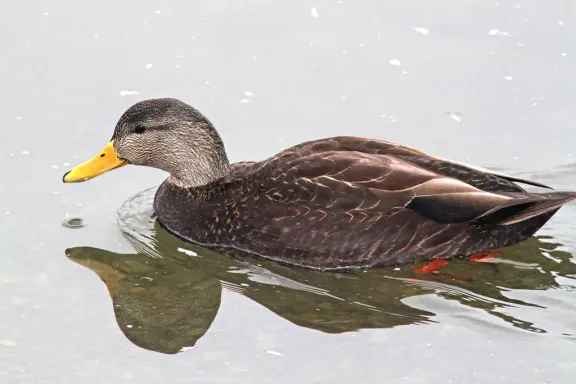
Waterfowl
American black duck
Anas rubripes
Same subfamily (Anatinae)