
Predators & furbearers
Ringed seal
Pusa hispida
- Group
- Predators & furbearers
- Size class
- Large (70–300 kg)
- Family
- Phocidae
Range
- Arctic
- Europe
Habitat
- Coast
Range
Countries it is found in
11 countries
- Canada
- Estonia
- Finland
- Greenland
- Japan
- Latvia
- Norway
- Russia
- Svalbard & Jan Mayen
- Sweden
- United States
Range from:ASM Mammal Diversity Database, GBIF occurrence records — read 2026-08-05
Chapter 01
Overview
The ringed seal (Pusa hispida) is a small earless seal of the Arctic and sub-Arctic and the most abundant and wide-ranging ice seal in the Northern Hemisphere, found throughout the Arctic Ocean, the Bering and Okhotsk Seas and the North Atlantic coasts, the Baltic included. Five subspecies are recognised, among them P. h. botnica in the Baltic and two freshwater forms in Lake Saimaa and Lake Ladoga. In the 19th century the Baltic held a few hundred thousand ringed seals. Hunting brought them close to extinction, and even after protection the population kept falling, probably because PCBs disrupted breeding; there are now about 5,500, some 70 per cent of them in the Bothnian Bay. The Baltic subspecies is listed as near threatened (NT) on the Swedish Red List. Globally the IUCN counts the species as least concern, but climate change and the loss of sea ice are the largest threat to it.
Chapter 02
Identification
The smallest and commonest seal of the Arctic, with a small head, a short cat-like snout and a plump body. The dark coat is marked with silver rings on the back and sides — the source of the name — over a silver belly. Adults are 100–175 cm long and 32–140 kg depending on subspecies and condition, averaging about 1.5 m and 50–70 kg; males are slightly larger than females. The small fore flippers carry claws more than 2.5 cm thick, used to keep breathing holes open through ice as thick as 1.8 m.
Chapter 03
Behaviour
Ringed seals are solitary, and when hauled out on ice they keep hundreds of metres apart. They prefer large floes and dense pack ice, keep breathing holes open through the winter — usually five to ten at a time — and so can use ice that other seals cannot. Food is small prey from some 72 species of fish and invertebrates, mostly taken on dives of 11–46 m. Females mature at four years, males at seven. In spring the female builds a lair in thick ice, often near a breathing hole, and gives birth to a single pup in March or April after a nine-month gestation; the pup is weaned after about two months. The polar bear is the main predator, and Arctic foxes and glaucous gulls take pups born outside lairs.
Chapter 04
Hunting
Ringed seals have long been an important part of the diet of Arctic indigenous peoples and are still harvested every year by many communities; Palaeo-Eskimo sites in Arctic Canada show seals taken 4,000–3,500 years ago. Inuit hunt them all year at their breathing holes, setting an indicator that moves when a seal comes up to breathe and then striking with a toggling harpoon. In October 2010 Finland allowed skyddsjakt on ringed seal in the Bothnian Bay for the first time in 22 years, aimed at individuals that had learned to take fish from traps and gear. In Sweden the ringed seal has no open season. Naturvårdsverket may decide on skyddsjakt on all three Swedish seal species, but licensjakt can be decided only for grey and harbour seal. From 1 July 2027 the Hunting Ordinance allows seal to be hunted all year in freshwater to prevent damage.
On the table
Meat & cooking
Table grade 3 of 53/5
- Sold as meat in a legal market
- Has a named traditional dish
- Published way to handle and cook it
- Eaten in more than one country
- No known health advisory
Before you eat it: In 2012 the Government of Nunavut warned pregnant women not to eat ringed seal liver because of elevated mercury, while stressing that traditional country food is still healthy for adults. Livsmedelsverket also names seal among the Swedish wild animals that can carry trichinella; the parasite dies at around 60–65 °C in an oven but needs over 70 °C on a grill.
Traditional preparations
- Suaasat
- A traditional Inuit soup made from seal, whale, reindeer or seabirds. Ringed and bearded seal are the most important part of the Inuit diet and often the largest part of a hunter's. Inuit cuisine — Wikipedia
- Liver and blood at the kill
- When a seal is brought home it is cut in a set way: the belly is opened and the hunters eat pieces of liver or drink blood from a cup first, sometimes with fat and brain mixed into the meat. Women and children then take the intestines and the rest of the liver, and the ribs and backbone last. Inuit cuisine — Wikipedia
Sources
Sources: Ringed seal — Wikipedia, Vikare — Wikipedia, Jaktförordning (1987:905) — Sveriges riksdag, Naturvårdsverket: Jakt på säl, Livsmedelsverket: Trikiner, Inuit cuisine — Wikipedia — read 2026-10-29
Cross-reference
Related species
Its closest relatives in the compendium, nearest kinship first.

Predators & furbearers
Grey seal
Halichoerus grypus
Same subfamily (Phocinae)
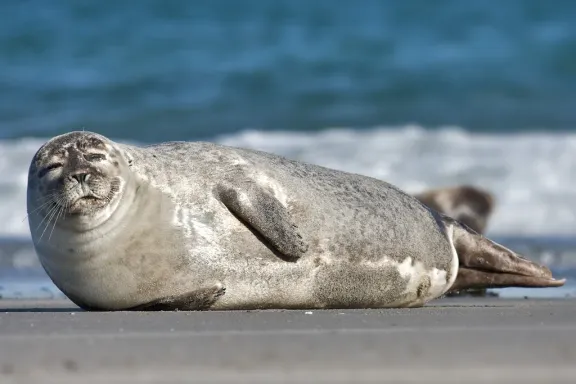
Predators & furbearers
Harbour seal
Phoca vitulina
Same subfamily (Phocinae)

Predators & furbearers
Wolverine
Gulo gulo
Same order (Carnivora)
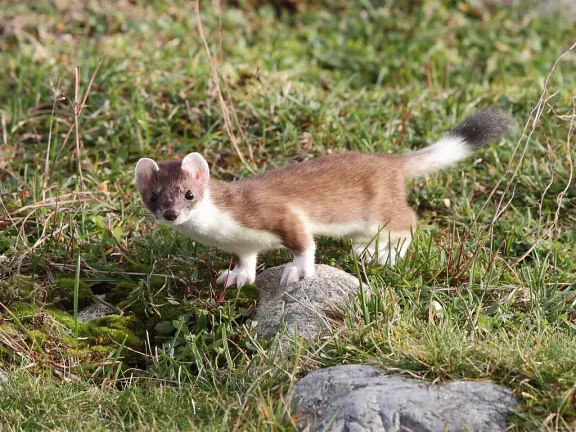
Predators & furbearers
Stoat
Mustela erminea
Same order (Carnivora)

Predators & furbearers
Gray wolf
Canis lupus
Same order (Carnivora)

Predators & furbearers
Eurasian lynx
Lynx lynx
Same order (Carnivora)