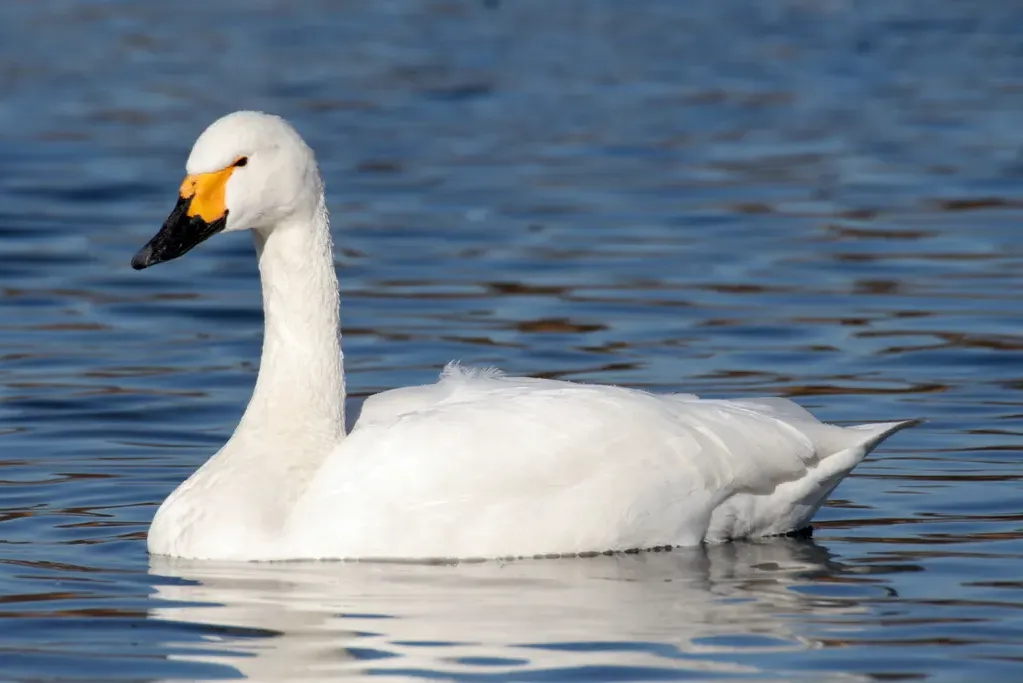
Photo:Maga-chanCC BY-SA 2.5
Waterfowl
Tundra swan
Cygnus columbianus
- Group
- Waterfowl
- Size class
- Small (under 10 kg)
- Family
- Anatidae
Range
- North America
- Arctic
Habitat
- Wetland
Range
Countries it is found in
33 countries
- Azerbaijan
- Belgium
- Bermuda
- Canada
- China
- Cuba
- Denmark
- Estonia
- Faroe Islands
- Finland
- Germany
- Greece
- Iran
- Japan
- Kazakhstan
- Latvia
- Lithuania
- Mexico
- Mongolia
- Netherlands
- North Korea
- Norway
- Poland
- Romania
Range from:Wikipedia country bird lists, GBIF occurrence records — read 2026-08-05
Chapter 01
Overview
The tundra swan (Cygnus columbianus) is the smallest of the Holarctic swans, breeding on Arctic and subarctic tundra and wintering in North America, Europe and Asia. It has two subspecies, sometimes treated as separate species: the whistling swan of North America, breeding on the coastal plains of Alaska and Canada, and Bewick's swan of Eurasia, breeding across the Siberian lowlands from the Kola Peninsula to the Pacific. Bewick's swans west of the Taymyr fly by the White Sea, the Baltic and the Elbe estuary to winter in Denmark, the Netherlands and the British Isles; whistling swans winter on the Pacific coast and on the Atlantic coast from Maryland to North Carolina. The name columbianus comes from the Columbia River, the type locality. The IUCN lists it as least concern, with 221,000–234,000 adults. The whistling swan is the most common swan in North America, and northeastern North Carolina alone holds 65,000–75,000 each winter, more than any other East Coast state. Bewick's swan is declining in north-western Europe for reasons not yet explained. In Sweden the mindre sångsvan passes in small numbers in early April and late October, mainly in the south-east, and the American subspecies has been recorded here as a vagrant.
Chapter 02
Identification
It measures 115–150 cm with a wingspan of 168–211 cm and weighs 3.4–9.6 kg; Bewick's is the smaller subspecies, males averaging 6.4 kg and females 5.7 kg. Adults are all white with black feet and a mostly black bill with a thin salmon-pink line along the gape and, depending on subspecies, more or less yellow at the base; birds from iron-rich waters get rust-stained heads and necks. Immatures are white mixed with dull grey, especially on the head, with a dirty-pink patch on the bill. Bewick's swan resembles the whooper swan, sångsvan, but is smaller and shorter-necked with a rounder head, and its bill always shows more black than yellow, with a blunt front edge to the yellow; the whooper's bill is more yellow than black, the yellow ending in a point. Each Bewick's swan's bill pattern is unique. The whistling swan's bill is almost entirely black. The calls are high-pitched honks rather like a black goose's; in flight Bewick's gives a soft, ringing bark and the whistling swan a high, three-syllable wow-wow-wow.
Chapter 03
Behaviour
In summer tundra swans live mainly on water plants — mannagrass, pondweeds, eelgrass — reached by dipping the head or upending, and at other seasons largely on leftover grain and potatoes gleaned from harvested fields; they feed by day. They are territorial and aggressive on the breeding grounds and sociable outside it, and migrating flocks fly in V formation, reportedly as high as 8 km. Pairs form at three or four years and stay together until one dies, the survivor often not pairing again for years. From late May the pair builds a large mound of plants on a raised site near open water and defends a large territory; the female lays 2–7 eggs, incubated for 29–32 days, while the male keeps watch and drives predators off, sometimes running with raised wings to look bigger. Whistling swan cygnets fledge in 60–75 days, twice as fast as mute swans, and Bewick's perhaps in 40–45; the young migrate with their parents in their first winter. Arctic and red foxes, jaegers, glaucous gulls and above all brown bears take eggs and young.
Chapter 04
Hunting
Hunting is the main cause of adult deaths. About 4,000 whistling swans are taken legally each year, with a further 6,000–10,000 killed by poachers and subsistence hunters, and lead poisoning from swallowed shot is also a major killer. Bewick's swan may not be hunted legally, yet almost half the birds examined carried lead shot in their bodies. Across its range the species faces poaching in north-western Europe and legal sport hunting in North America. In the United States swans may be hunted by state permit only, and the permit is personal, not transferable and must be carried in the field. For 2026–2027 the Atlantic Flyway seasons are 7 November–31 January in Delaware, 7 November–30 January in North Carolina and 15 November–31 January in Virginia, one tundra swan per permit. North Carolina issues 5,000 permits a year, and its wildlife commission warns that tundra swans can be confused with trumpeter swans and non-native mute swans. In Alaska's 2026 subsistence harvest, hunting and egg gathering are closed in units 9(D) and 10. In Sweden the mindre sångsvan has no open season: the Hunting Ordinance allows only skyddsjakt on the whooper swan in some cases, never on this species, so it is protected.
Sources
Sources: Tundra swan — Wikipedia, Mindre sångsvan — Wikipedia (sv), North Carolina Wildlife Resources Commission: Tundra swan, U.S. Department of the Interior: Migratory Game Bird Hunting Memorandum 2026–02, 2026–2027 seasons in certain States, U.S. Fish & Wildlife Service: Regulations for the 2026 Alaska Subsistence Spring/Summer Migratory Bird Harvest, Jaktförordning (1987:905) — Sveriges riksdag — read 2026-10-29
Cross-reference
Related species
Its closest relatives in the compendium, nearest kinship first.
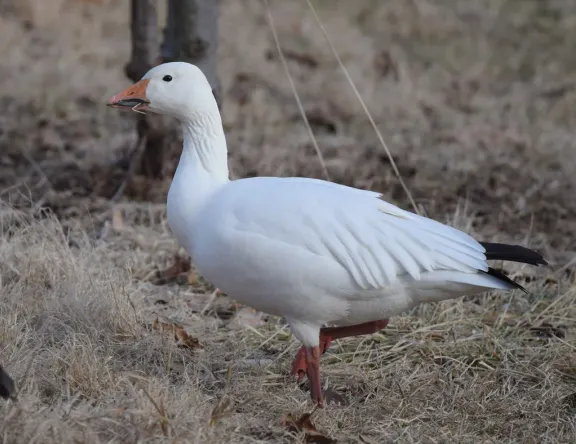
Waterfowl
Snow goose
Anser caerulescens
Same subfamily (Anserinae)
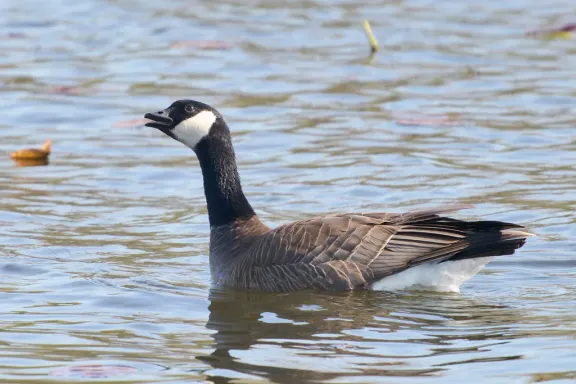
Waterfowl
Cackling goose
Branta hutchinsii
Same subfamily (Anserinae)
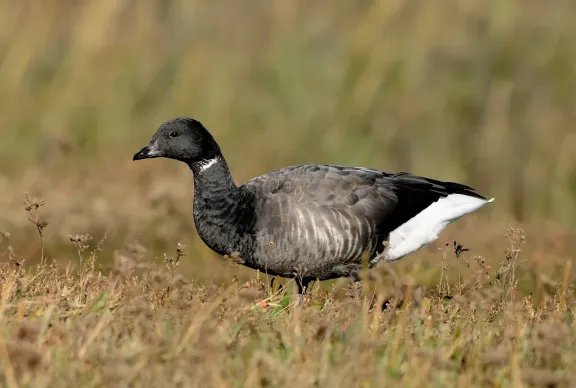
Waterfowl
Brant
Branta bernicla
Same subfamily (Anserinae)
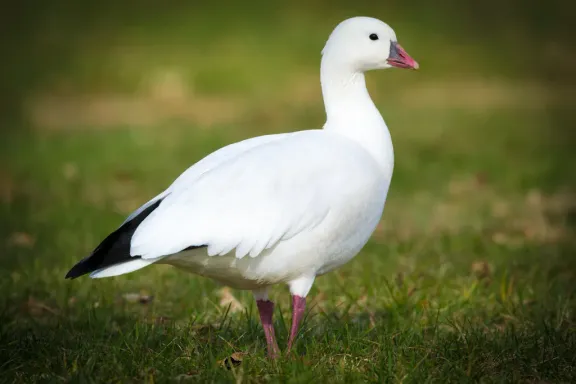
Waterfowl
Ross’s goose
Anser rossii
Same subfamily (Anserinae)
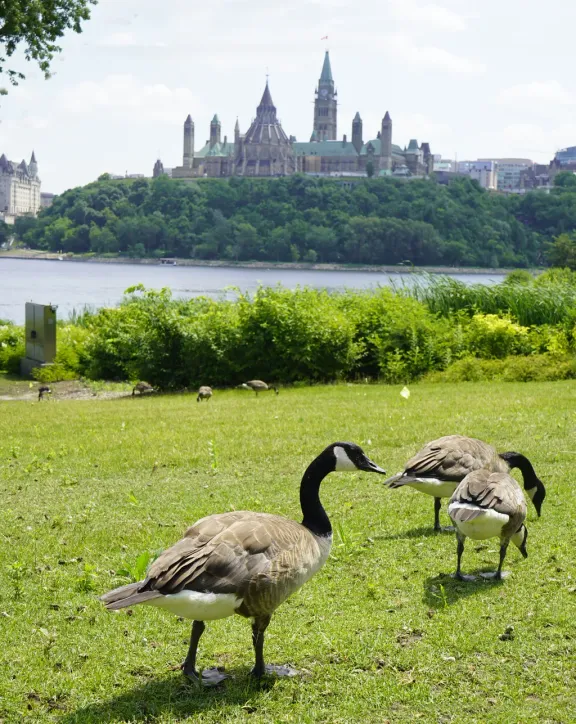
Waterfowl
Canada goose
Branta canadensis
Same subfamily (Anserinae)
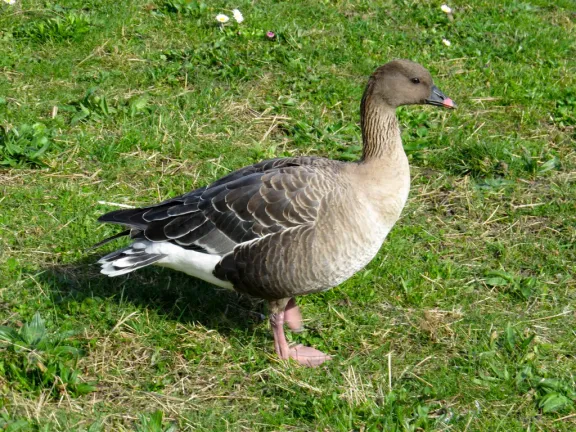
Waterfowl
Pink-footed goose
Anser brachyrhynchus
Same subfamily (Anserinae)