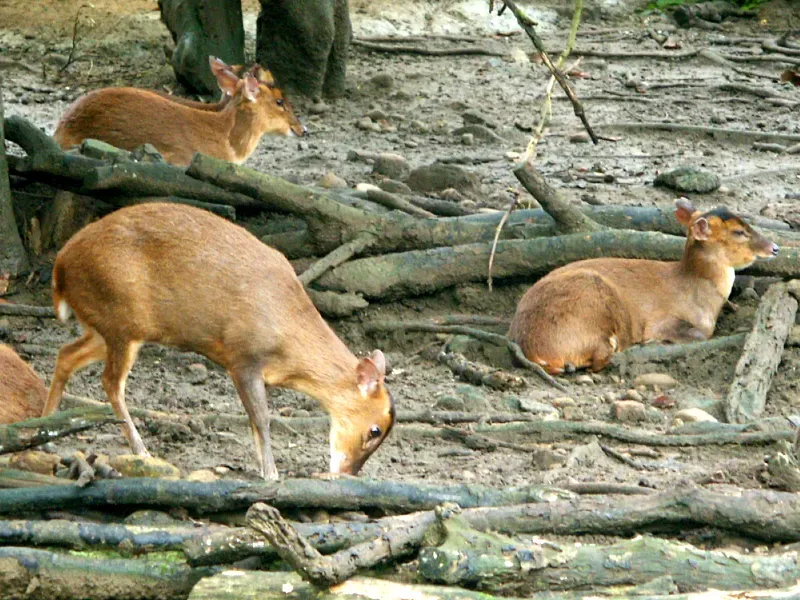
Photo:KaurJmebCC BY-SA 2.0
Big game
Reeves’s muntjac
Muntiacus reevesi
- Group
- Big game
- Size class
- Medium (10–70 kg)
- Family
- Cervidae
Range
- Asia
- Europe
Habitat
- Forest
- Farmland
Range
Countries it is found in
5 countries
- Belgium
- China
- Japan
- Taiwan
- United Kingdom
Range from:ASM Mammal Diversity Database, GBIF occurrence records — read 2026-08-05
Chapter 01
Overview
Reeves's muntjac (Muntiacus reevesi), also called the Chinese muntjac and in Swedish official usage röd muntjak, is a small deer of south-eastern China, from Gansu to Yunnan, and Taiwan. It lives from the lowlands to 3,500 m, in tropical lowland forest, temperate mountain forest, conifer stands and high meadows, and is named after John Reeves, a naturalist with the British East India Company in the 19th century. The IUCN lists it as least concern, and in Hong Kong it is protected. Introduced populations are another matter. The Duke of Bedford released muntjac into the woods around Woburn Abbey in 1901, and later releases spread them across England, where the population was put at 104,000 in 2008 and colonies now reach everywhere south of the Humber. It has also been introduced to Ireland, Belgium, the Netherlands and Japan, where escapes from zoos in Chiba and on Izu Ōshima have grown into tens of thousands of animals. Naturvårdsverket records it as not present in Sweden.
Chapter 02
Identification
A small, reddish-brown deer about 0.5 m at the shoulder and 0.95 m long, with a short tail up to 10 cm and a weight of 10 to 18 kg when grown. The face is striped, and the belly is creamy white, the paler fur running up to the neck and chin and under the tail, which is dark above. Bucks carry short antlers, usually 10 cm or less, and long upper canines — tusks of about 5 cm. Does have bony lumps on the forehead and small black spots. The Taiwanese subspecies, the Formosan Reeves's muntjac, is darker than the others.
Chapter 03
Behaviour
Reeves's muntjac is solitary and most active at dawn and dusk, keeping to forest and shrubland. It feeds on herbs, blossoms, succulent shoots, fungi, berries, grasses and nuts, strips bark, and takes eggs and carrion when it finds them. Its name of barking deer comes from the bark it gives when mating or provoked. Both sexes hold small territories marked with secretion from the glands in front of the eyes. Fighting bucks use their antlers to push a rival off balance and then wound it with their tusks. Does are sexually mature within their first year, mating happens all year round, and gestation lasts 209 to 220 days.
Chapter 04
Hunting
Reeves's muntjac has been on the European Union's list of invasive alien species of Union concern since 2016, so it may not be imported, bred, transported, sold or released anywhere in the EU. In England it has no close season, since it breeds at no fixed time of year; the British Deer Society recommends that only immature or heavily pregnant does be culled so that no dependent young are left behind. Since 2019 English law also forbids catching and re-releasing muntjac. Ireland brought in a year-round hunting season after sightings in 2008. In Sweden the Hunting Ordinance lists röd muntjak among the alien game species that may be hunted all year, 1 July to 30 June, to prevent damage. Naturvårdsverket's decision of February 2026 also lets hunters appointed by Svenska Jägareförbundet take up to ten a year anywhere in the country until the end of 2027. Its low-fat meat is noted for its culinary qualities.
Sources
Sources: Reeves's muntjac — Wikipedia, Muntiacus reevesi — Wikipedia (sv), Naturvårdsverket: Invasiva främmande arter på EU:s förteckning — djur (augusti 2025), Naturvårdsverket: Jakt efter invasiva främmande arter inom uppdrag för Svenska Jägareförbundet (NV-26-001857), Jaktförordning (1987:905) — Sveriges riksdag, The British Deer Society: Deer open season dates — read 2026-10-29
Cross-reference
Related species
Its closest relatives in the compendium, nearest kinship first.
Big game
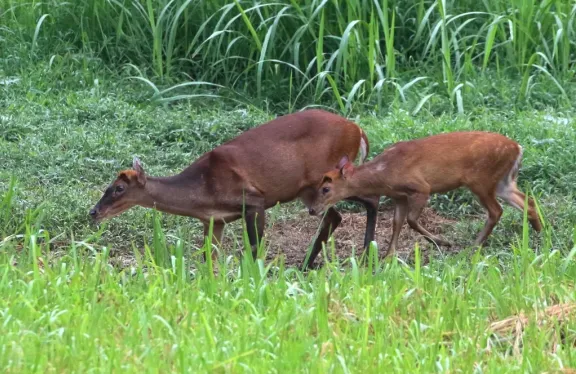
Indian muntjac
Muntiacus muntjak
Same genus (Muntiacus)
Big game
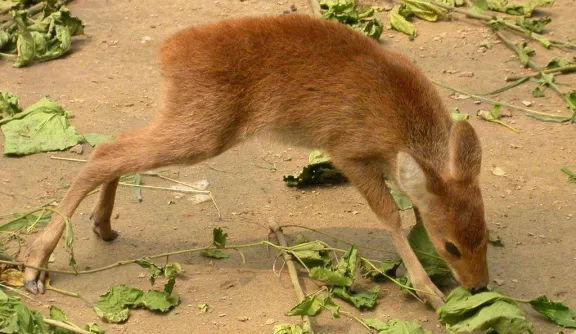
Chinese water deer
Hydropotes inermis
Same family (Cervidae)
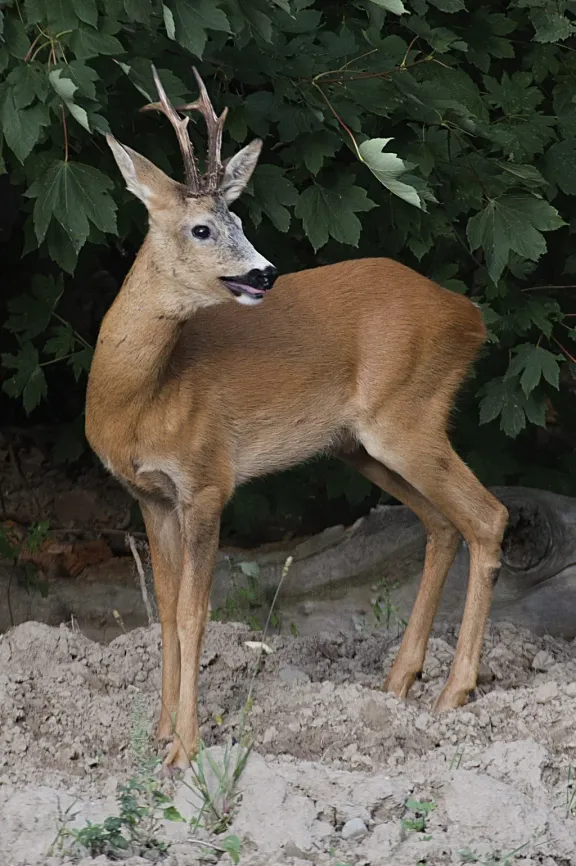
Big game
Roe deer
Capreolus capreolus
Same family (Cervidae)
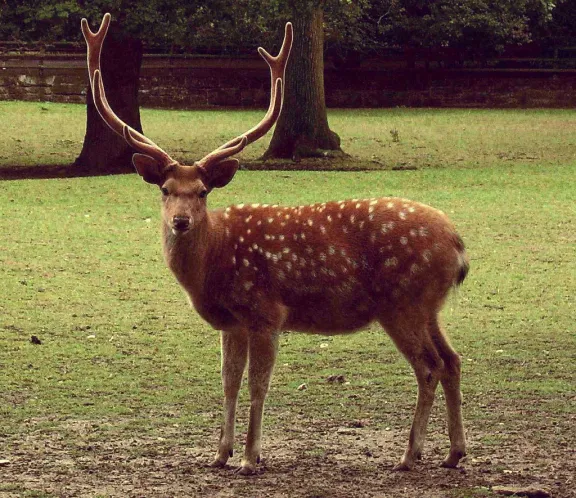
Big game
Sika deer
Cervus nippon
Same family (Cervidae)
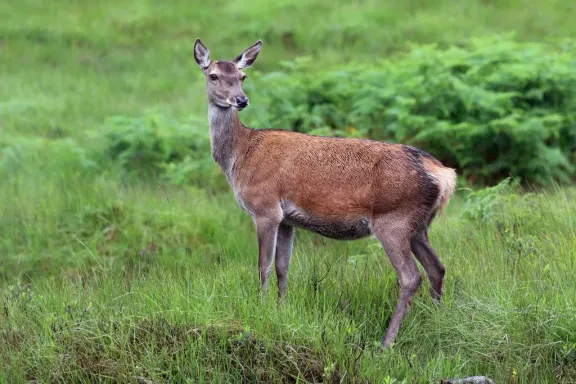
Big game
Red deer
Cervus elaphus
Same family (Cervidae)
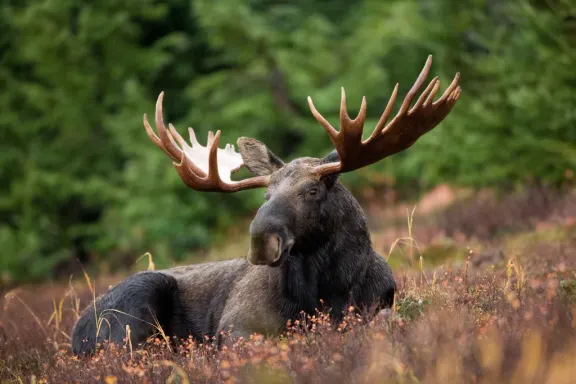
Big game
Moose
Alces alces
Same family (Cervidae)